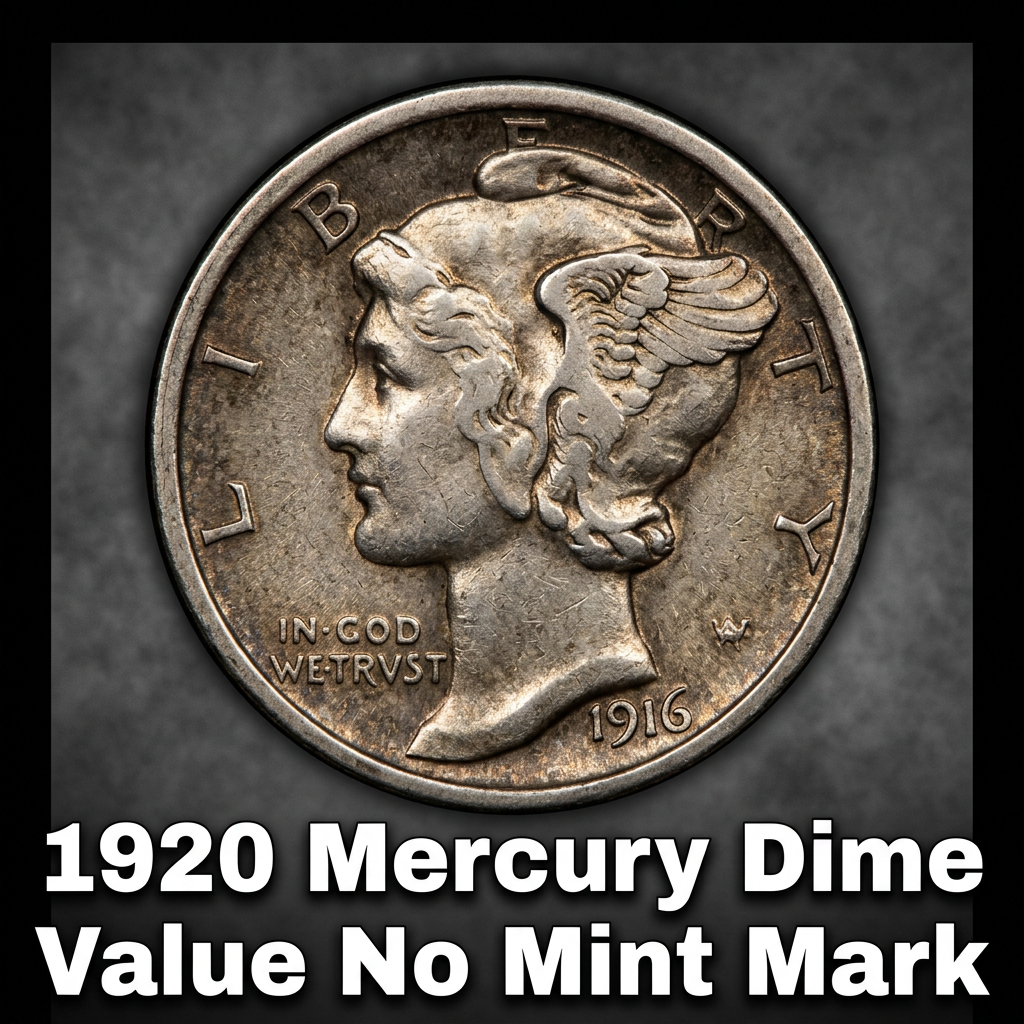
The 1920 Mercury Dime with no mint mark is worth anywhere from $3 to $5 in heavily worn condition, climbing to $30 or more in fine shape, and potentially reaching $100 or beyond in top mint state grades. If you just found one in an old coin jar or inherited collection, you’re in the right place to learn exactly what it’s worth.
Getting Started: Identifying Your 1920 Mercury Dime
Before you can put a dollar value on your coin, you need to make sure you’re holding the right one. The 1920 Mercury Dime — officially called the Winged Liberty Head Dime — features a portrait of Liberty wearing a winged cap on the obverse, often mistaken for the Roman god Mercury, which is how the nickname stuck. On the reverse, you’ll see a fasces bundle with an olive branch.
To confirm you have the Philadelphia Mint version with no mint mark, flip the coin over and look just to the left of the “E” in “ONE” at the bottom of the reverse. If there’s no letter there, your coin was struck in Philadelphia. Coins from Denver carry a “D” and those from San Francisco carry an “S.” The no-mint-mark version is the most common of the three 1920 issues, which affects its value compared to the rarer branch mint coins.
If you’re unsure whether your coin is genuine or want to double-check the details, a good coin identification app can help you confirm the design type, mint mark location, and key features right from your phone — no coin shop visit needed.
1920 Mercury Dime No Mint Mark Value by Grade
Coin value is almost entirely driven by condition, also called grade. A Mercury Dime that has been circulated for decades looks very different from one pulled from an original roll. Here’s a straightforward breakdown of what collectors and dealers typically pay for the 1920 Philadelphia Mercury Dime:
| Grade | Description | Estimated Value |
|---|---|---|
| Good (G-4) | Heavy wear, outline visible | $3 – $5 |
| Fine (F-12) | Moderate wear, some detail | $6 – $10 |
| Extremely Fine (EF-40) | Light wear on high points | $20 – $35 |
| About Uncirculated (AU-50) | Slight wear, most luster | $40 – $60 |
| Mint State (MS-63) | No wear, some marks | $70 – $120 |
| Mint State (MS-65+) | Gem quality, full luster | $150 – $300+ |
For the most up-to-date auction records and dealer pricing, you can check current 1920 Mercury Dime price data across mint state grades to see exactly what examples in various conditions have sold for recently.
What Makes the 1920 No Mint Mark Special (or Not)
Here’s the honest truth: the 1920 Philadelphia Mercury Dime is a common date. The Philadelphia Mint struck over 59 million of them that year, which means survivors are plentiful in lower grades. For worn examples, collector demand is steady but values stay modest simply because supply is high.
That said, the story changes dramatically as the grade goes up. Finding a true gem uncirculated example — one with full bands on the reverse fasces, sharp luster, and minimal contact marks — is actually quite difficult. Collectors prize Full Bands (FB) designated coins, which must show complete separation in the horizontal bands of the fasces. A 1920 Mercury Dime graded MS-65 Full Bands can bring two to three times the price of a regular MS-65. Silver content also plays a role: each Mercury Dime contains 0.0723 troy ounces of silver, giving even worn coins a base melt value tied to the current silver spot price.
How to Get the Best Price for Your 1920 Mercury Dime
If you’re thinking about selling, condition is everything. Don’t clean your coin — cleaning removes the natural patina and surface details that collectors value, and a cleaned coin is worth significantly less. Your best options for selling include local coin dealers, online auction platforms like eBay, coin shows, or submitting higher-grade examples to a third-party grading service like PCGS or NGC before listing.
For a quick and reliable estimate from home, CoinKnow is a popular tool among everyday collectors. CoinKnow lets you photograph your coin and get an instant grade estimate along with current market values, so you go into any sale already knowing what a fair price looks like. You can also browse the complete 1920 Mercury Dime value guide with detailed price breakdowns by grade to cross-reference before making any decisions.
Silver Melt Value and Why It Matters
Even if your 1920 Mercury Dime is heavily worn and worth only a few dollars to a collector, it still has real silver inside. These coins are 90% silver and 10% copper. With silver prices fluctuating around $25–$30 per troy ounce in recent years, a single Mercury Dime carries a melt value of roughly $1.80 to $2.20 just for its metal content.
This means no Mercury Dime is truly worthless. The melt value acts as a price floor. CoinKnow and similar tools automatically factor in current silver spot prices when estimating coin values, making it easy to track both collector value and metal value in one place. Whether you have a single dime or a whole collection, understanding both sides of the value equation helps you make smarter decisions.
FAQ
Q: Is the 1920 Mercury Dime with no mint mark rare?
A: No, it’s actually one of the more common Mercury Dimes. The Philadelphia Mint produced over 59 million of them. However, finding one in uncirculated or gem condition is much harder, and those examples carry real collector premiums.
Q: Should I get my 1920 Mercury Dime professionally graded?
A: It depends on the condition. If your coin looks uncirculated — sharp details, original luster, no wear — then submitting it to PCGS or NGC could be worth the cost, since a certified MS-65 or higher can sell for $150 or more. For worn circulated coins, the grading fee usually isn’t worth it.
Q: How do I tell if my Mercury Dime has Full Bands?
A: Look at the horizontal bands crossing the center of the fasces on the reverse. Full Bands means all the bands show clear, complete separation with no weakness or flatness. This is best examined under magnification. Coins with the FB designation are worth significantly more than standard examples in the same grade.