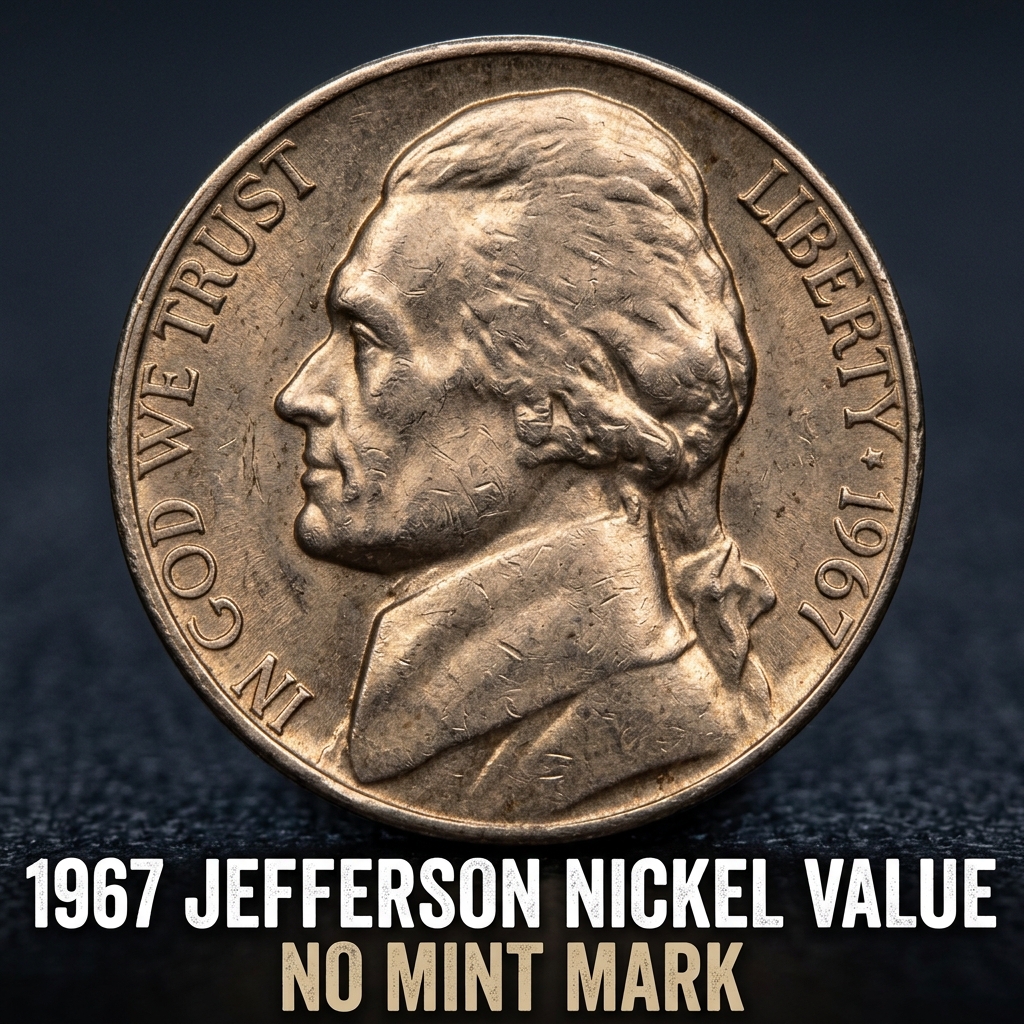
The 1967 Jefferson Nickel with no mint mark is worth anywhere from face value (5 cents) in heavily worn condition to $25 or more in pristine uncirculated grades — and a few exceptional examples have sold for over $100. If you just found one in an old coin jar, you’re in the right place to find out exactly what you’ve got.
What Does “No Mint Mark” Mean on a 1967 Jefferson Nickel?
If you’re flipping your coin over and wondering why there’s no letter stamped on it, don’t worry — that’s completely normal for this date. In 1967, the U.S. Mint was dealing with a nationwide coin shortage and ramped up production significantly. All nickels from that year were struck at the Philadelphia Mint, and at the time, Philadelphia coins did not carry a mint mark. So “no mint mark” doesn’t mean something is missing — it just tells you your coin was made in Philly.
This is one of the first things a coin identification app will help you figure out when you’re trying to place an old coin. Knowing where and when a coin was minted is step one in understanding its value. The 1967 Jefferson Nickel had a massive mintage — over 107 million pieces — which is part of why most circulated examples aren’t worth much above face value. But condition is everything in coin collecting, and high-grade examples are a different story entirely.
1967 Jefferson Nickel Value by Grade
The value of your 1967 nickel with no mint mark depends almost entirely on its condition, also called its “grade.” Circulated coins that have been passed through pocket change will show wear on Jefferson’s cheekbones, hair details, and Monticello on the reverse. These typically aren’t worth more than a few cents above face value unless you’re selling to a collector building a date set.
Uncirculated coins — those that were never spent and kept in decent storage — are a different matter. A coin graded MS-63 (a typical uncirculated piece with some blemishes) might bring $1 to $3. Sharper examples at MS-65 and above begin to attract more serious collector interest and dollars. You can check detailed 1967 nickel value breakdowns by grade to get a clearer picture of where your coin might fall.
| Grade | Description | Estimated Value |
|---|---|---|
| Good (G-4) | Heavy wear, major details visible | Face value (~$0.05) |
| Fine (F-12) | Moderate wear, some detail present | $0.10 – $0.25 |
| Extremely Fine (EF-40) | Light wear on high points | $0.50 – $1.00 |
| MS-63 (Uncirculated) | No wear, some contact marks | $1.50 – $3.00 |
| MS-65 (Gem Uncirculated) | Strong luster, minimal marks | $8 – $20 |
| MS-67 (Superb Gem) | Near perfect, exceptional eye appeal | $50 – $150+ |
Special Strike SMS Coins and Why They Matter
Here’s something most people don’t know about 1967 nickels: the U.S. Mint also produced Special Mint Set (SMS) coins that year. Instead of traditional proof sets, the Mint released SMS coins with a sharper strike and more polished appearance. These SMS nickels can be worth significantly more than a regular business-strike coin of the same date.
An SMS 1967 Jefferson Nickel in top condition can fetch $15 to $75 or more depending on the grade assigned by professional grading services like PCGS or NGC. If your coin has an unusually sharp strike and mirror-like fields on the surfaces, it might be an SMS piece worth getting professionally evaluated. CoinKnow can help you identify whether you’re looking at a standard strike or something more special — the app’s database includes SMS varieties alongside standard issues.
How to Assess Your Coin’s Condition at Home
You don’t need to be a professional numismatist to do a basic condition check. Start by looking at Jefferson’s face under good lighting — ideally natural light or a single lamp. If the high points of his cheekbones and hair are smooth and featureless, the coin is worn. If those details are sharp and the surfaces still have some shine (called “luster”), you might have an uncirculated example.
Avoid cleaning your coin under any circumstances. Cleaning destroys luster and makes a coin worth far less to collectors, even if it looks shinier to your eye. Handle coins by their edges, store them in soft holders, and if you think you’ve got something in high grade, it’s worth the modest fee to have it evaluated. CoinKnow offers an easy scanning feature that gives you a quick grade estimate before you decide whether professional grading is worth pursuing. For current auction records and certified population data, the 1967 Jefferson Nickel MS price and population data at CoinHix is a solid reference point used by collectors and dealers alike.
Is the 1967 Jefferson Nickel Worth Keeping?
For most people, a worn 1967 nickel is just a nickel. But if you’ve stumbled onto one in crisp uncirculated condition — especially an MS-65 or better — it’s worth setting aside. The real winners are the rare high-grade MS-67 examples and SMS coins that have crossed auction blocks for impressive sums. Even if your coin turns out to be average, the process of checking it is a great introduction to coin collecting.
Use resources like CoinKnow to build your knowledge, and don’t rush to sell or spend anything until you know what you have. Sometimes a five-cent coin is worth quite a bit more — you just have to know where to look.
—
FAQ
Q: Why does my 1967 Jefferson Nickel have no mint mark — is it an error?
A: No, it’s not an error. In 1967, all nickels were produced at the Philadelphia Mint, which did not use a mint mark at that time. The absence of a mint mark is completely normal and expected for this date.
Q: Can a 1967 nickel with no mint mark be worth more than $1?
A: Absolutely. While circulated examples are worth close to face value, uncirculated specimens graded MS-65 or higher can be worth $8 to $20 or more. Exceptional MS-67 coins and SMS pieces have sold for $50 to over $150 at auction.
Q: How do I know if my 1967 nickel is an SMS coin?
A: SMS coins typically have sharper detail, a more satin-like or semi-proof surface, and better overall strike quality compared to regular business-strike coins. If your coin looks unusually crisp and reflective compared to others from the same year, it may be an SMS piece. A professional grading service or a tool like CoinKnow can help confirm it.