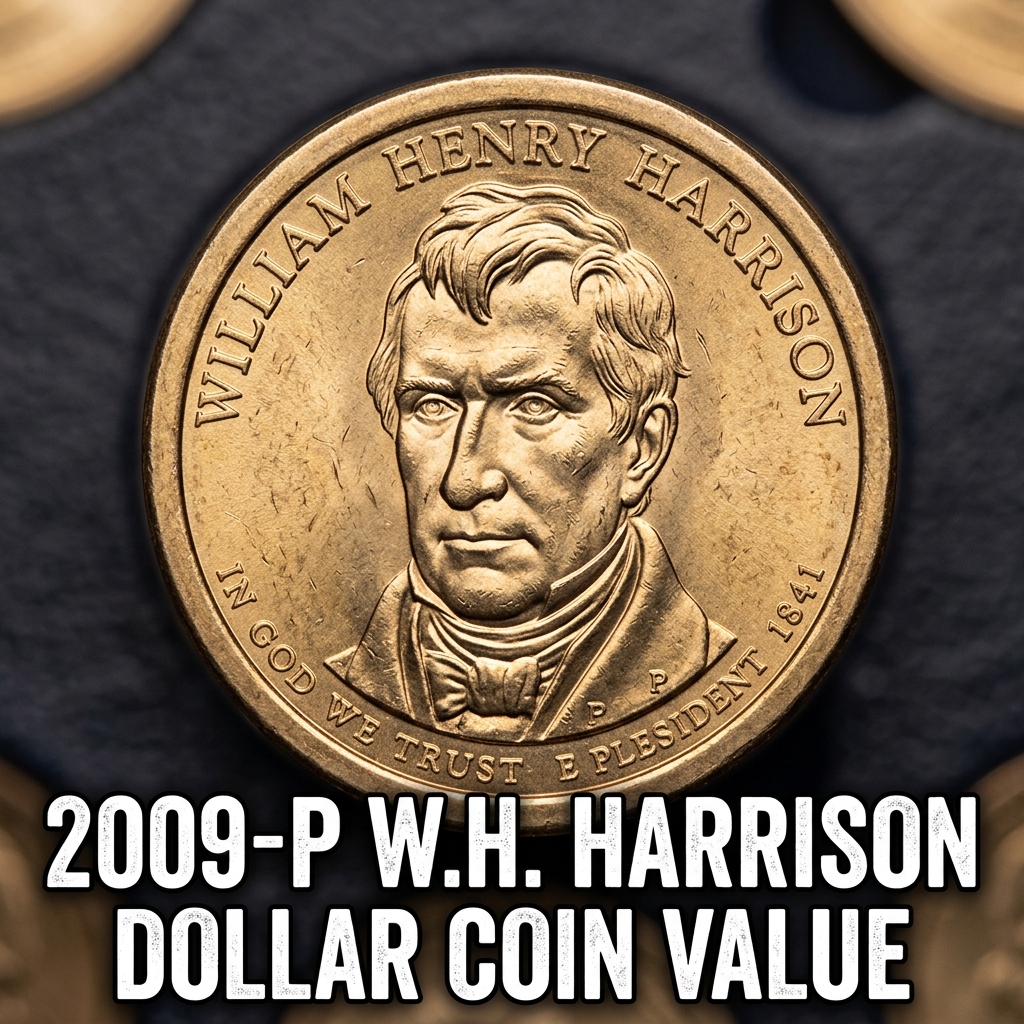
The 2009-P William Henry Harrison Dollar coin is worth between $1.25 and $5 for most circulated examples, but uncirculated specimens in top grades can fetch $10 to $30 or more depending on condition.
If you recently found one of these golden-colored coins in your change jar or inherited a collection, you’re in the right place. This guide breaks down everything you need to know about the 2009-P W.H. Harrison Dollar — from mintage numbers to what makes certain coins more valuable than others. If you’re not sure what coin you have, a coin identification app can help you confirm the exact variety before you start researching values.
What Is the 2009-P W.H. Harrison Presidential Dollar?
The 2009-P William Henry Harrison Dollar is part of the Presidential Dollar series, a program launched by the U.S. Mint in 2007 to honor each American president on a rotating basis. Harrison was the 9th President of the United States, known for delivering the longest inaugural address in history — and serving the shortest term, just 31 days before dying of pneumonia in 1841.
The “P” in the coin’s name tells you it was struck at the Philadelphia Mint. These coins were produced in large numbers for general circulation, which is why most of them aren’t worth a fortune. Still, condition plays a big role in value, and collectors will pay a premium for coins that never touched a pocket or cash register.
The obverse features a portrait of Harrison designed by Joseph Menna, while the reverse carries the standard Statue of Liberty design used across the entire Presidential Dollar series. The edge of the coin is lettered, displaying the year, mint mark, and the phrase “E PLURIBUS UNUM” and “IN GOD WE TRUST.”
2009-P Harrison Dollar Mintage and Rarity
The Philadelphia Mint struck approximately 43,260,000 of these coins in 2009 — a significant number, but notably lower than Presidential Dollars minted earlier in the series. By 2009, public interest in dollar coins was fading, and the U.S. Mint scaled back production accordingly.
That lower mintage is actually good news if you’re hoping your coin is worth something. Fewer coins made means slightly stronger collector demand, especially for examples in pristine uncirculated condition. For comparison, some earlier Presidential Dollars had mintages well above 100 million, making the Harrison issue a bit more appealing in the long run.
For collectors tracking certified grades and auction results, you can check current market price data for 2009-P dollar coins in MS grades to see how the market is performing in real time.
2009-P Harrison Dollar Value by Grade
Here’s a quick breakdown of typical values for the 2009-P W.H. Harrison Dollar based on coin grade:
| Grade | Description | Estimated Value |
|---|---|---|
| Good / Fine | Well-circulated, visible wear | $1.25 – $2.00 |
| Extremely Fine (EF-45) | Light wear on high points | $2.00 – $3.50 |
| Mint State (MS-63) | Uncirculated, some bag marks | $4.00 – $8.00 |
| Mint State (MS-65) | Gem uncirculated, sharp strike | $10.00 – $18.00 |
| Mint State (MS-67+) | Near-perfect, rare at this level | $30.00 – $100.00+ |
Keep in mind these are general market estimates. Coins certified by PCGS or NGC often sell at the higher end of each range because buyers trust the third-party grading. If you want a deeper look at how the 2009 Presidential Dollar values stack up across the full series, this detailed 2009 Presidential Dollar value guide covers all four issues from that year.
Error Coins and Special Varieties Worth More
Not every 2009-P Harrison Dollar is created equal. A small number were produced with known errors, and these can be worth significantly more than face value. The most famous error type in the Presidential Dollar series is the “plain edge” or “missing edge lettering” variety. These coins were accidentally released without the edge inscription — and they can sell for anywhere from $20 to over $100 depending on condition.
Another variety to watch for is double-die errors, where part of the design appears doubled. These are rare but do exist in the Presidential Dollar series. If your coin looks slightly off — letters that seem thick or doubled — it’s worth having it examined by a professional.
CoinKnow is a great tool for identifying potential errors quickly. The app lets you photograph your coin and compare it against known varieties in seconds, saving you a trip to the coin shop for basic questions.
Should You Hold or Sell Your 2009-P Harrison Dollar?
For most people, a circulated 2009-P Harrison Dollar isn’t going to pay off a vacation. But it’s also not worthless — especially if you have a roll or a bag of them in uncirculated condition. The Presidential Dollar series is still relatively young, and collector interest tends to grow as time passes and coins become harder to find in top grades.
If you’re serious about getting maximum value, consider submitting your best examples to PCGS or NGC for professional grading. High-grade certified coins almost always command stronger prices at auction or through major dealers.
CoinKnow can also help you track current buy and sell prices in your area, making it easier to decide whether now is the right time to sell or whether holding makes more sense for your specific coins.
—
FAQ
Q: Is the 2009-P W.H. Harrison Dollar worth keeping?
A: Yes, especially if your coin is uncirculated. Circulated examples are only worth a dollar or two above face value, but gem-quality specimens graded MS-65 or higher can bring $10 to $18 or more. Coins with errors could be worth considerably more.
Q: How do I know if my Harrison Dollar has the missing edge lettering error?
A: Hold the coin by its edges and look carefully around the rim. If you see no lettering at all — no year, no mint mark, no “E PLURIBUS UNUM” — you likely have an error coin. You can also use CoinKnow to photograph and compare your coin against documented error examples.
Q: What’s the difference between the 2009-P and 2009-D Harrison Dollar?
A: The main difference is the mint mark — “P” for Philadelphia and “D” for Denver — and the mintage numbers. The 2009-D Harrison Dollar had a mintage of around 55,160,000, slightly higher than the Philadelphia issue. Both coins have similar values, though collector preferences can sometimes push one over the other in higher grades.