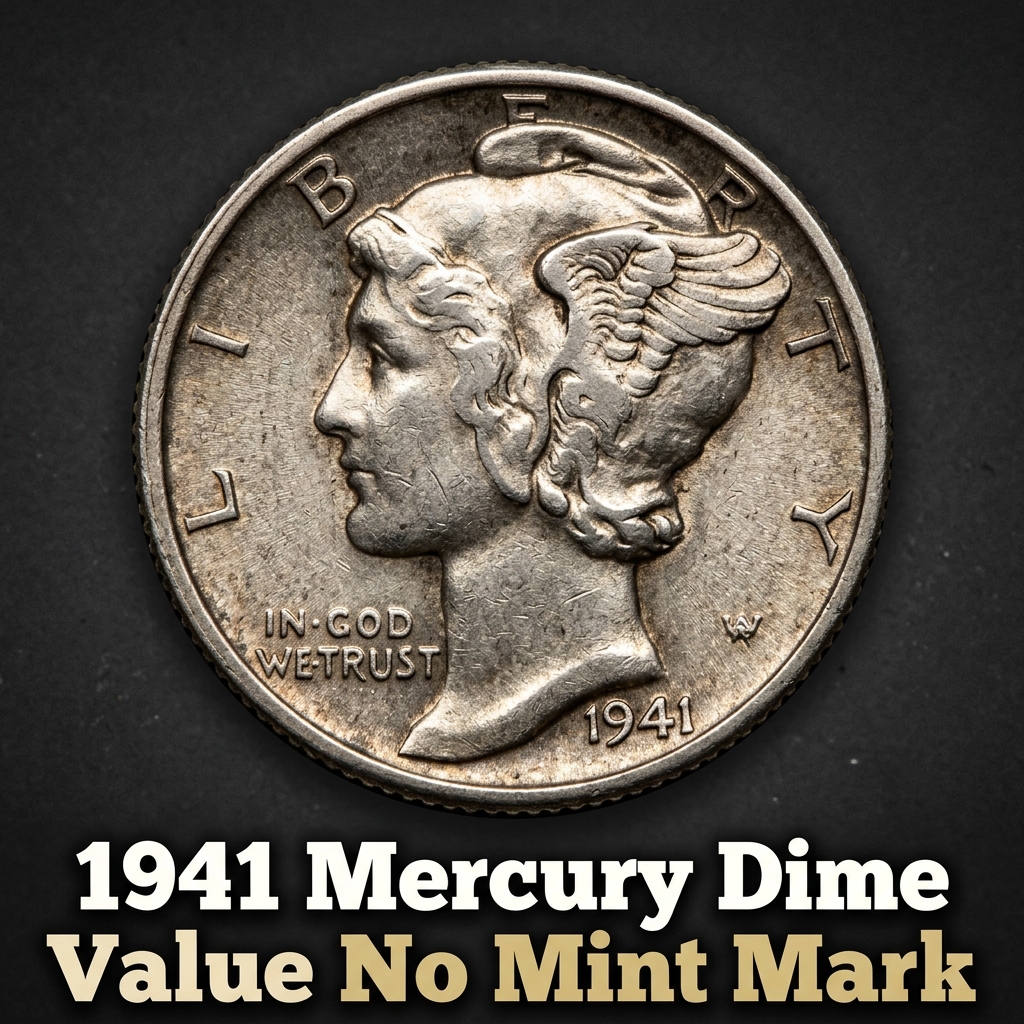
The 1941 Mercury Dime with no mint mark is worth anywhere from $2 to $3 in heavily worn condition, but can fetch $20 or more in uncirculated grades — and top-condition examples have sold for hundreds of dollars at auction. If you found one of these in an old jar or inherited coin collection, you’re in the right place.
coin identification app tools have made it much easier for everyday people to identify old coins without needing a magnifying glass and a stack of price guides. Before you do anything else with your 1941 Mercury Dime, it helps to understand what you actually have — and why the Philadelphia mint version (no mint mark) is one of the most commonly found Mercury Dimes in circulation today.
What Is the 1941 Mercury Dime No Mint Mark?
The Mercury Dime, officially called the Winged Liberty Head Dime, was minted from 1916 to 1945. The coin features the profile of Liberty wearing a winged cap — which many people mistook for the Roman god Mercury, and the nickname stuck. The reverse shows a fasces (a bundle of rods) and an olive branch, symbolizing strength and peace.
The 1941 no mint mark version was struck at the Philadelphia Mint, which did not stamp a mint mark on coins during this era. This is the most plentiful of the three 1941 dime varieties — Philadelphia, Denver (D), and San Francisco (S). The Philadelphia Mint produced over 175 million of these dimes in 1941, making them widely available today. That high mintage is the main reason most circulated examples are modestly priced. Still, condition matters enormously — a beautiful uncirculated coin is a completely different story than one that’s been rattling around in someone’s pocket for 80 years.
How Much Is the 1941 Mercury Dime No Mint Mark Worth?
Value comes down to grade and eye appeal. Coins graded by a professional service like PCGS or NGC will command higher prices at auction. Here’s a general value breakdown to help you estimate what your coin might be worth:
| Grade | Description | Estimated Value |
|---|---|---|
| Good (G-4) | Heavy wear, design visible but flat | $2 – $3 |
| Fine (F-12) | Moderate wear, some details remain | $3 – $5 |
| Extremely Fine (EF-40) | Light wear on high points only | $6 – $10 |
| About Uncirculated (AU-55) | Slight wear, most mint luster present | $12 – $20 |
| Mint State (MS-63) | Uncirculated, minor contact marks | $25 – $45 |
| Mint State (MS-65) | Gem uncirculated, sharp details | $60 – $120+ |
For a deeper look at how this coin performs across grade levels, you can check out 1941 Mercury Dime MS-grade price data to see recent auction records and certified coin sales.
What Makes a 1941 Mercury Dime More Valuable?
Beyond basic grade, two factors can push the value of a 1941 Mercury Dime no mint mark significantly higher: full bands designation and eye appeal.
The “full bands” (FB) designation refers to the horizontal bands on the fasces on the reverse of the coin. When these bands are fully separated and well-struck, the coin earns an FB designation from grading services — and that can dramatically increase its value. An MS-65 coin might sell for $60 to $120 in standard grade, but an MS-65 FB example could be worth $300 or more.
Luster and strike quality also matter to serious collectors. A coin with brilliant original mint luster, sharp details, and no distracting spots or cleaning will always be worth more than one that looks dull or has been improperly cleaned. Never clean your coins — it almost always reduces their value. If you’re curious about the full range of 1941 dime values across different grades and mint marks, resources like this can give you a solid side-by-side comparison.
How to Check Your Coin’s Grade at Home
You don’t need to be an expert numismatist to get a rough idea of your coin’s grade. Start by examining both sides under good lighting. Look at the high points — on a Mercury Dime, that’s the hair above Liberty’s ear and the bands on the fasces. The more detail that’s worn away, the lower the grade.
CoinKnow is a handy app that helps everyday collectors like you identify coins and get quick value estimates using your phone’s camera. It’s a great starting point if you’re new to coin collecting or just trying to sort through a jar of old change. Of course, for valuable coins you plan to sell, getting a professional grade from PCGS or NGC is always worth the investment.
Should You Sell or Hold Your 1941 Mercury Dime?
If your coin is heavily worn, it’s worth close to its silver melt value — about $1.60 to $2 based on the coin’s 90% silver content and current silver prices. That’s always a floor value you can count on. But if your coin looks clean, shiny, and detailed, it could be worth having it professionally evaluated.
Mercury Dimes have a devoted collector base, and well-preserved examples continue to perform well at coin shows and online auctions. The CoinKnow app can also help you track market trends and get a second opinion before you decide whether to sell, submit for grading, or hang onto your piece of history.
—
FAQ
Q: How do I know if my 1941 dime is from Philadelphia?
A: If your 1941 Mercury Dime has no mint mark on the reverse, it was struck at the Philadelphia Mint. Look just to the left of the “E” in “ONE” — Denver coins show a “D” and San Francisco coins show an “S.” No letter means Philadelphia.
Q: Is the 1941 Mercury Dime made of silver?
A: Yes. All Mercury Dimes, including the 1941 no mint mark, are composed of 90% silver and 10% copper. Each coin contains about 0.0723 troy ounces of pure silver, giving it a base metal value even in poor condition.
Q: How can I tell if my Mercury Dime has full bands?
A: Look at the horizontal bands crossing the fasces on the reverse. If the two middle bands are completely separated and clearly defined with no merging, your coin may qualify for the Full Bands designation. Use a magnifying loupe or try CoinKnow to get a closer look before sending it off for professional grading.