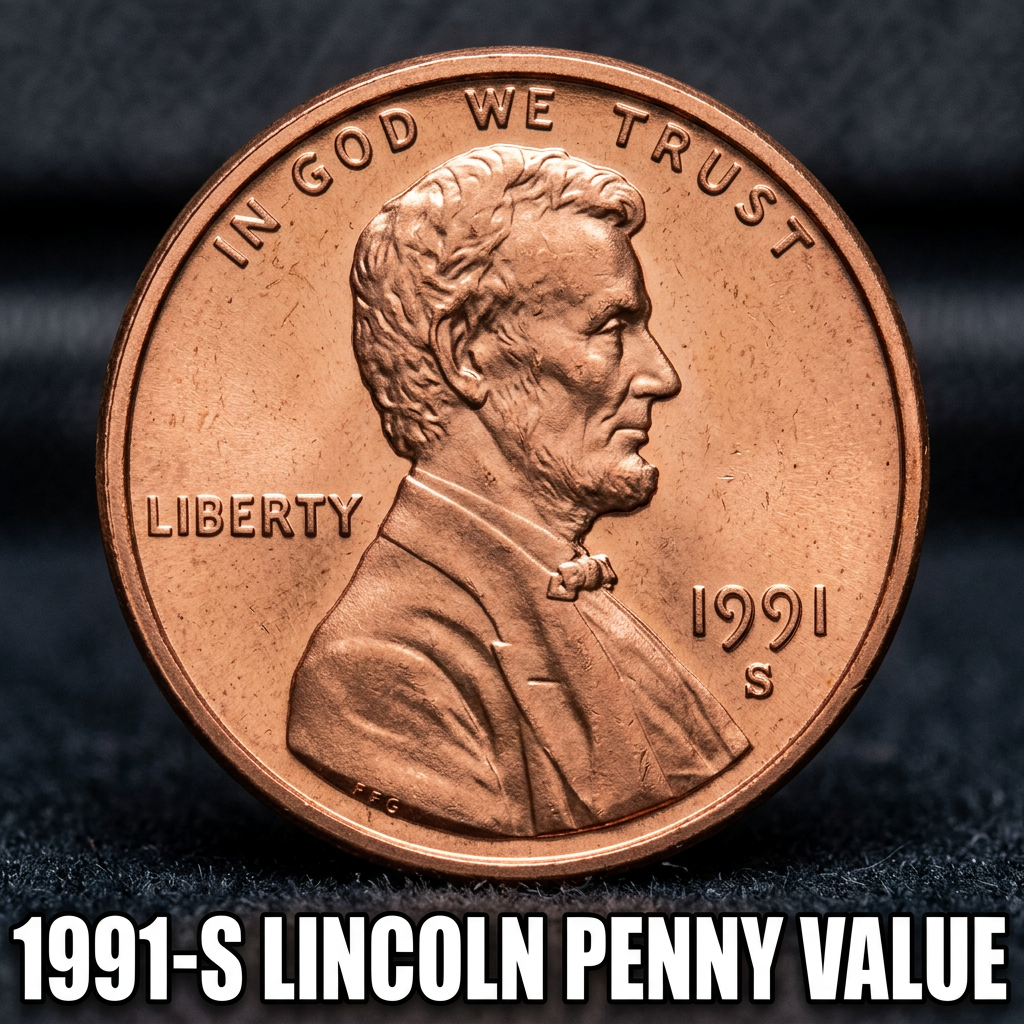
The 1991-S Lincoln Penny is worth anywhere from $3 in lightly circulated condition to over $10 in pristine proof grades — and certain high-grade examples have sold for significantly more at auction. If you found one of these coins and want to know what it’s really worth, you’re in the right place.
coin identification app tools have made it easier than ever for everyday collectors to identify and value coins like the 1991-S penny right from their phones. Whether you’re sorting through an old coin jar or inherited a collection, knowing the details behind this coin can save you from underselling something special.
—
What Makes the 1991-S Lincoln Penny Different
The “S” mintmark on a Lincoln penny tells you it was struck at the San Francisco Mint. But here’s the thing — the 1991-S Lincoln cent was never made for circulation. It was produced exclusively as a proof coin, meaning it was specially struck with polished dies on carefully prepared blanks to create a mirror-like finish. These coins came packaged in official U.S. Mint proof sets and were sold directly to collectors.
That distinction matters a lot. Because these coins were never handled or spent in everyday commerce, most surviving examples are in excellent condition. The 1991-S proof Lincoln cent has a cameo or deep cameo appearance on the best examples, where the raised design elements look frosty white against a shiny, reflective background. This contrast is what collectors are really chasing.
If you’re looking for detailed 1991-S Lincoln penny price data by grade, comparing values across different proof grades will help you understand where your coin stands in the market.
—
How Much Is the 1991-S Lincoln Penny Worth?
Value depends almost entirely on grade and cameo designation. Here’s a simple breakdown of what these coins typically sell for:
| Grade | Designation | Estimated Value |
|---|---|---|
| PR-65 | Standard Proof | $3 – $5 |
| PR-67 | Cameo (CAM) | $5 – $8 |
| PR-69 | Deep Cameo (DCAM) | $8 – $15 |
| PR-70 | Deep Cameo (DCAM) | $25 – $60+ |
A perfect PR-70 DCAM example is rare and commands a real premium. Most ungraded 1991-S pennies still in their original proof set packaging are worth a few dollars. For a more complete picture, you can explore the full 1991 penny value breakdown including all mint marks to see how the S-mint proof compares to the Philadelphia and Denver business strike coins from the same year.
—
How to Check Your 1991-S Penny’s Condition
Even though proof coins start life in near-perfect condition, they can be damaged over time. Scratches, fingerprints, and improper storage all reduce a coin’s grade — and its value. When examining your 1991-S Lincoln penny, look for:
– Hairlines: Tiny scratches on the reflective fields from cleaning or mishandling
– Contact marks: Small nicks on the coin’s surface from touching other coins
– Toning: Natural or artificial discoloration that may or may not reduce value depending on its appearance
If you’re not sure how to assess your coin’s condition, CoinKnow is a handy app that walks you through grading basics and helps you understand what professional graders look for. Many collectors use CoinKnow to get a ballpark grade before deciding whether to send a coin to PCGS or NGC for official certification.
The 1991-S proof set had a mintage of approximately 2.87 million sets. That’s not rare by any means, but PR-70 DCAM examples are still genuinely hard to find.
—
Should You Get Your 1991-S Penny Graded?
For most 1991-S Lincoln pennies, professional grading isn’t cost-effective. Grading fees at PCGS or NGC typically start around $30–$50 per coin, which can easily exceed what the coin is worth in average proof grades. However, if you believe your coin is a true PR-70 DCAM — perfectly struck with no flaws visible under magnification — grading could be worthwhile since certified examples in that top grade can sell for $40 or more.
The best approach: photograph your coin in good lighting, compare it against graded examples on auction sites, and use CoinKnow to help narrow down its likely grade. If the numbers still make sense after factoring in fees, then submit it for professional certification.
—
FAQ
Q: Was the 1991-S Lincoln penny made for everyday use?
A: No. The 1991-S penny was made exclusively as a proof coin at the San Francisco Mint and sold in official U.S. Mint proof sets. It was never intended for circulation.
Q: How do I know if my 1991-S penny is worth getting graded?
A: Look for a mirror-like reflective surface with strong frosted contrast on Lincoln’s portrait and the lettering. If it appears flawless under a loupe, a PR-70 DCAM grade is possible and may justify grading fees. For average proof examples, the cost usually isn’t worth it.
Q: Where is the mintmark on a 1991-S Lincoln penny?
A: The “S” mintmark is located on the obverse (heads side) of the coin, just below the date on the right side. It’s small but clearly visible without magnification on most examples.