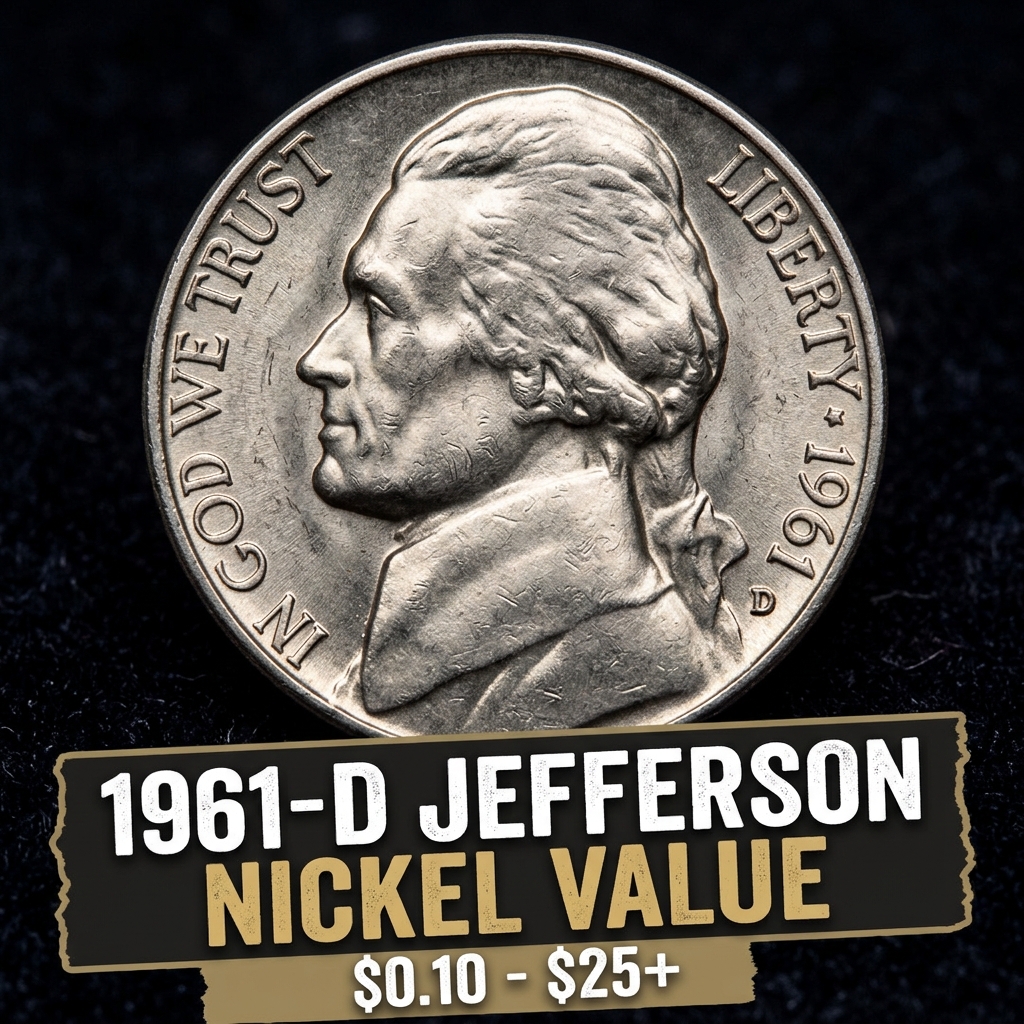
The 1961-D Jefferson Nickel is worth anywhere from 5 cents in heavily worn condition to over $50 or more in pristine mint state — and a few exceptional examples have sold for hundreds of dollars at auction. If you found one of these coins in a jar, drawer, or old collection, you’re in the right place to find out what it’s worth.
What Makes the 1961-D Jefferson Nickel Special?
The “D” mint mark on your coin tells you it was struck at the Denver Mint in 1961. That year, Denver produced over 229 million Jefferson Nickels — a huge mintage that generally keeps values modest for average circulated examples. But that doesn’t mean your coin is worthless. Condition is everything in coin collecting, and even a common-date coin can be surprisingly valuable if it survived the decades in great shape.
If you’re not sure how to tell where your coin was made or what the details mean, a coin identification app can help you quickly read mint marks, identify coin types, and get an instant ballpark on value — especially useful if you’re new to coin collecting and just trying to figure out what you’ve got.
The 1961-D nickel features the classic portrait of Thomas Jefferson on the obverse (front) and Monticello, his famous Virginia home, on the reverse. It’s part of the long-running Jefferson Nickel series that started in 1938 and continues today.
1961-D Jefferson Nickel Value by Grade
The biggest factor in your coin’s value is its condition, which collectors call its “grade.” Coins graded on a scale from 1 (barely identifiable) to 70 (perfect, as struck) can vary wildly in price. Here’s a general breakdown of what the 1961-D nickel is worth across common grades:
| Grade | Description | Estimated Value |
|---|---|---|
| Good (G-4) | Heavy wear, design visible | $0.10 – $0.25 |
| Fine (F-12) | Moderate wear, major details clear | $0.25 – $0.50 |
| Extremely Fine (EF-40) | Light wear on high points | $0.75 – $1.50 |
| Mint State (MS-63) | Uncirculated, some marks | $5 – $15 |
| Mint State (MS-65) | Gem uncirculated, sharp strike | $20 – $55 |
| Mint State (MS-67) | Superb gem, near flawless | $200+ |
For the most up-to-date auction results and certified coin sales, you can browse recent 1961-D Jefferson Nickel price data across mint state grades to see what real buyers are paying right now.
How to Tell If Your 1961-D Nickel Is Worth More
Most 1961-D nickels you’ll find in circulation are worth only face value or a few cents above it. But there are a few things that can push your coin’s value significantly higher:
Full Steps designation: On the reverse, Monticello’s steps are one of the most important details to examine. When the steps are sharply and completely struck — showing five or six full, distinct horizontal lines — grading services like PCGS or NGC may award the coin a “Full Steps” (FS) designation. A 1961-D Jefferson Nickel graded MS-65 FS can be worth dramatically more than a standard MS-65 example of the same coin.
Strike quality: Denver Mint coins from this era sometimes suffered from weak strikes, which can blur fine details. A strongly struck coin stands out immediately.
Original luster: Uncirculated coins that still have their original cartwheel luster — that subtle shine you see when you tilt the coin under a light — are far more desirable than cleaned or dull examples. Never clean your coins; it destroys value instantly.
CoinKnow is a great resource to learn more about what these details mean and how they affect your coin’s grade and market value.
Where to Sell Your 1961-D Jefferson Nickel
If you’ve determined your coin is in decent shape and possibly worth more than face value, you have several selling options. Online marketplaces like eBay are the most accessible for everyday sellers — you can search completed listings to see what similar coins actually sold for (not just asking prices). Coin dealers at local shops will buy your coins but typically offer wholesale prices, around 50–60% of retail value.
For high-grade examples — especially any coin that might qualify for a Full Steps designation — it’s worth having the coin professionally graded by PCGS or NGC before selling. A certified grade dramatically increases buyer confidence and often results in much higher sale prices.
You can also check out a full breakdown of what the 1961 Jefferson Nickel is worth across all grades and mint marks to compare your coin’s potential value before deciding whether to sell, hold, or get it graded.
Quick Tips Before You Do Anything With Your Coin
Before you sell, trade, or even show off your 1961-D Jefferson Nickel, keep these simple rules in mind:
– Don’t clean it. Even a gentle rinse under water can leave microscopic scratches that ruin surface quality and kill the coin’s numismatic value.
– Handle it by the edges. Fingerprints leave oils that can permanently damage the coin’s surface over time.
– Store it properly. A simple 2×2 cardboard flip or a proper coin holder will protect your coin from further wear and environmental damage.
– Use trusted tools. CoinKnow offers easy-to-understand grading guides and coin value references that can help you assess what you have before visiting a dealer.
Taking these small steps now can mean the difference between a coin worth $5 and one worth $50 or more at sale.
FAQ
Q: How do I know if my 1961-D Jefferson Nickel has Full Steps?
A: Look closely at the bottom of Monticello on the reverse. Count the horizontal lines running across the steps at the base of the building. If you can clearly see five or six complete, unbroken lines, your coin may qualify for the Full Steps designation. A magnifying loupe (10x) helps a lot. For a definitive answer, you’ll need a professional coin grading service like PCGS or NGC to evaluate it.
Q: Is the 1961-D nickel made of silver?
A: No. The 1961-D Jefferson Nickel is made of a standard copper-nickel alloy — 75% copper and 25% nickel. The U.S. only made silver nickels during World War II (1942–1945), known as “War Nickels.” Those coins have a large mint mark above Monticello and contain 35% silver. Your 1961-D is not one of them.
Q: Where can I find the mint mark on my 1961-D nickel?
A: Flip the coin to the reverse side and look just to the right of Monticello. You should see a small letter “D,” which stands for the Denver Mint. If there’s no mint mark, it was made at the Philadelphia Mint. CoinKnow has visual guides that can help you locate mint marks on Jefferson Nickels and other common U.S. coins if you’re having trouble spotting it.