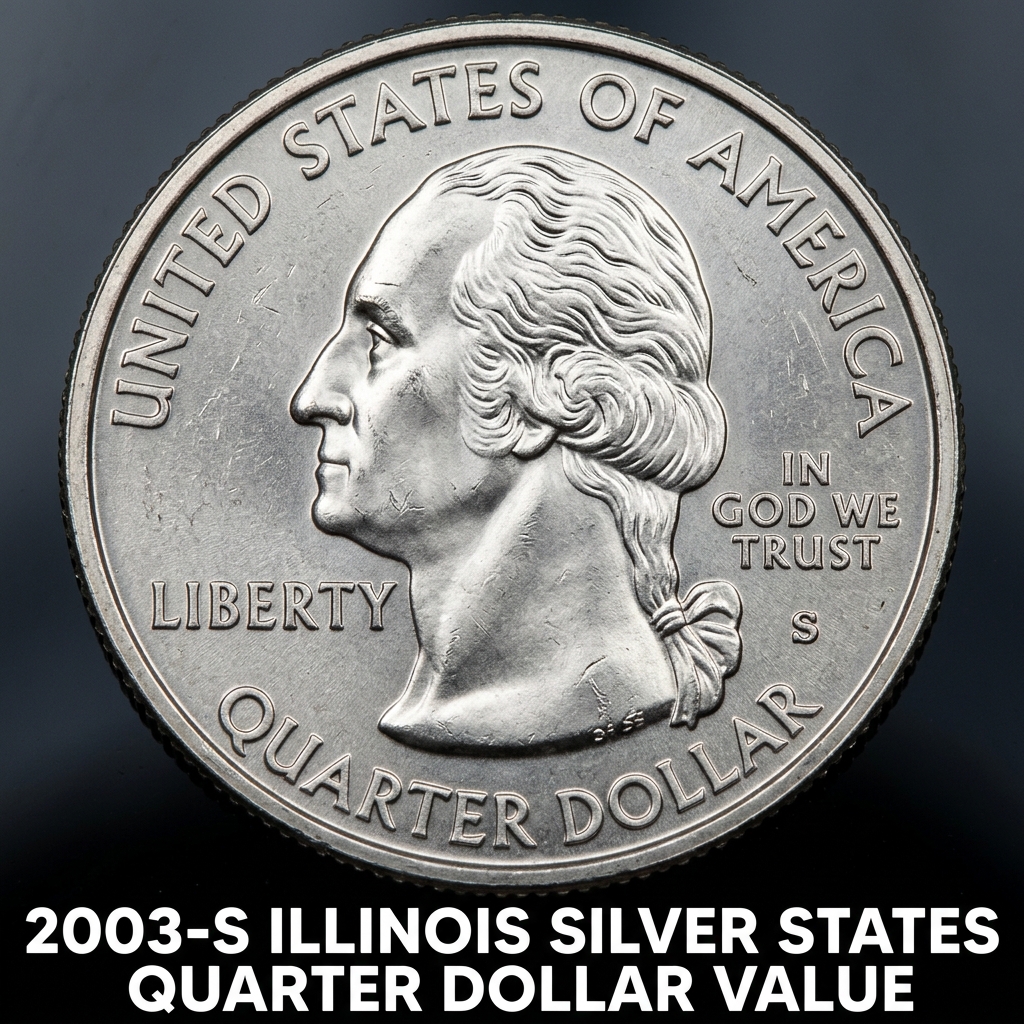
The 2003-S Illinois Silver State Quarter is worth anywhere from $5 in lightly circulated condition to over $20 or more for top-grade proof examples — and if you stumbled across one in an old collection or inherited coin stash, you may be sitting on a genuinely desirable piece of American numismatic history.
What Exactly Is the 2003-S Illinois Silver State Quarter?
Before diving into values, it helps to know what makes this coin special. The 2003-S Illinois quarter was struck at the San Francisco Mint as part of the 50 State Quarters Program, which ran from 1999 to 2008. The “S” mintmark means it was never intended for general circulation — these were produced exclusively as proof coins for collectors. What makes the Silver version even more interesting is that it’s composed of 90% silver and 10% copper, unlike the standard clad quarters you find in pocket change. That silver content alone gives it a baseline melt value, and the collectible proof quality adds even more to the equation. If you’re not sure whether your coin is the silver version or the regular clad proof, a good coin identification app can help you sort that out quickly using your smartphone camera.
The reverse design features Abraham Lincoln standing in front of the Chicago skyline, with a farm scene and an eagle. It’s a beautifully detailed design, and the proof finish makes those details pop in brilliant cameo contrast. Collectors love the 2003-S Illinois Silver quarter both for its design and its composition, making it a solid find for anyone who comes across one.
How Much Is the 2003-S Illinois Silver Quarter Worth Today
The value of this coin depends largely on its condition and grade. Since all 2003-S Silver quarters were struck as proofs, they typically come in high grades — PR-65 to PR-70 on the Sheldon scale. Even so, there’s a meaningful difference in price between a standard proof and a near-perfect gem. Here’s a general breakdown of current market values:
| Grade | Estimated Value |
|---|---|
| PR-65 (Proof) | $5 – $8 |
| PR-67 (Gem Proof) | $8 – $14 |
| PR-69 (Deep Cameo) | $14 – $20 |
| PR-70 (Perfect Proof) | $25 – $50+ |
For the most up-to-date market data, you can check out current auction prices and grade-by-grade values for the 2003 Illinois quarter to see how recent sales are trending. Markets shift, and silver prices fluctuate, so real-time data always beats a printed price guide.
Silver Melt Value and Why It Matters
One thing that sets the 2003-S Silver State Quarter apart from regular proof quarters is that it has actual intrinsic silver value. Each coin contains approximately 0.1808 troy ounces of pure silver. When silver trades around $25 per troy ounce (prices vary), that gives the coin a melt value of roughly $4.50 just for the metal alone. This creates a natural price floor — the coin is almost never worth less than its silver content. When silver prices rise, even average-grade examples gain value automatically. This is one reason why silver state quarters are often considered a smarter long-term hold than their clad counterparts. If you want a broader look at the full value breakdown for 2003 quarters across different mint marks and compositions, that resource covers the complete picture in one place.
How to Identify and Grade Your 2003-S Illinois Silver Quarter
First, look for the “S” mintmark on the obverse (heads side), just below Washington’s portrait. If it says “S,” it’s a San Francisco proof — not a business strike. To tell if it’s silver rather than clad, examine the edge. Silver quarters show a solid silver-gray edge with no copper stripe. Clad quarters have a visible orange-brown copper layer sandwiched between the outer layers. You can also weigh it — silver quarters weigh 6.25 grams, while clad quarters weigh 5.67 grams. For grading at home, look for mirror-like fields and sharp frosted devices (the raised design elements). The strongest cameo contrast earns the coveted “Deep Cameo” or “Ultra Cameo” designation from grading services like PCGS or NGC. CoinKnow is a fantastic tool for beginners who want help identifying coins and understanding grade ranges without needing expert knowledge right away.
Should You Sell, Hold, or Get It Graded
If you found a 2003-S Illinois Silver Quarter in original proof packaging or a sealed government set, keep it that way — original packaging preserves value significantly. If it’s already loose, handle it by the edges only and consider a protective coin flip or holder. Getting it professionally graded by PCGS or NGC makes sense if you believe it might be PR-69 or PR-70, since those top-tier grades can fetch notably higher prices. For coins that are clearly lower-grade proofs, selling raw (ungraded) on eBay or to a local coin dealer is usually more practical. CoinKnow can also give you a quick sense of what a fair selling price looks like before you commit to any transaction, which is especially helpful for first-time sellers who don’t want to leave money on the table.
FAQ
Q: How do I know if my 2003-S quarter is silver or just a regular proof?
A: Check the edge of the coin. A silver quarter will show a uniform silver-gray edge with no visible copper stripe. You can also weigh it — silver quarters weigh 6.25 grams compared to 5.67 grams for clad versions.
Q: Is the 2003-S Illinois Silver Quarter rare?
A: It’s not extremely rare — the U.S. Mint produced around 1.2 million silver proof quarters in 2003 — but it is far less common than regular circulation coins, and collector demand keeps values solid, especially in top grades.
Q: Can I use CoinKnow to identify and value my 2003-S Illinois quarter?
A: Absolutely. CoinKnow is designed to help everyday coin finders identify what they have, understand its grade, and get a reasonable value estimate — all from your phone without needing prior coin expertise.