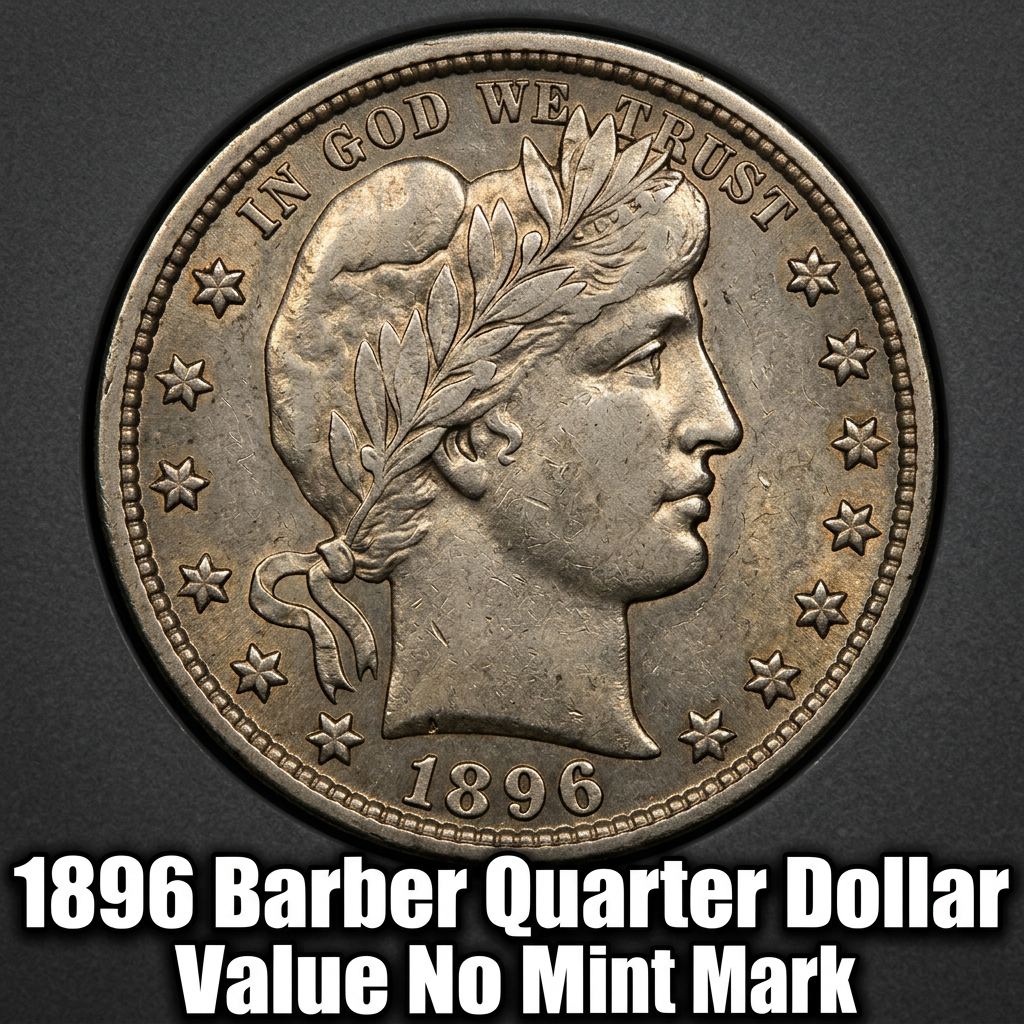
The 1896 Barber Quarter Dollar (Philadelphia, no mint mark) is worth anywhere from $6 in heavily worn condition to over $400 or more in high mint state grades. If you found one of these old silver coins tucked away in a drawer or inherited collection, you’re holding a piece of genuine American history — and it could be worth more than you think.
What Is the 1896 Barber Quarter?
The 1896 Barber Quarter is part of a series designed by U.S. Mint Chief Engraver Charles E. Barber, which ran from 1892 to 1916. The obverse features a classic portrait of Liberty wearing a laurel wreath and a Phrygian cap, while the reverse shows a heraldic eagle with a shield on its chest. Coins struck at the Philadelphia Mint carry no mint mark — that’s the version we’re focusing on here.
These quarters were made for everyday commerce, so most surviving examples show heavy wear. But collectors prize the 1896 Barber Quarter for its clean design and the challenge of finding one in decent condition. If you’re trying to identify whether what you have is actually a Barber Quarter, a good coin identification app can help you confirm the design, date, and mint mark within seconds.
The Philadelphia Mint struck approximately 3,874,762 of these quarters in 1896, making them reasonably available in lower grades but scarce in higher ones.
Understanding Coin Grades and the 1896 Barber Quarter Value
Coin grading is what separates a $6 coin from a $400 one. Grading follows the Sheldon scale, which runs from 1 (barely identifiable) to 70 (perfect uncirculated). For Barber Quarters, the key details to look for are the words “IN GOD WE TRUST” above Liberty’s head and the clarity of the hair above her ear — these areas wear first.
Here’s a simple breakdown of the 1896 Barber Quarter Dollar value with no mint mark across grades:
| Grade | Description | Estimated Value |
|---|---|---|
| AG-3 (About Good) | Heavily worn, outline visible | $6 – $8 |
| G-4 to G-6 (Good) | Major details visible, flat | $8 – $14 |
| VG-8 to VG-10 (Very Good) | Some hair detail returns | $18 – $28 |
| F-12 to F-15 (Fine) | Hair details clearer, motto visible | $35 – $55 |
| VF-20 to VF-35 (Very Fine) | Moderate wear, solid detail | $65 – $110 |
| EF-40 to EF-45 (Extremely Fine) | Light wear on high points only | $135 – $190 |
| MS-60 to MS-63 (Mint State) | Uncirculated, some bag marks | $225 – $325 |
| MS-64 to MS-65+ (Gem) | Sharp, lustrous, near perfect | $375 – $500+ |
Silver Melt Value and Why It Matters
Even a heavily worn 1896 Barber Quarter has intrinsic value because it’s made of 90% silver. Each coin contains approximately 0.1808 troy ounces of pure silver. With silver hovering around $28–$30 per ounce in recent years, that means the melt value alone sits around $5.00 to $5.50. This acts as a floor — your coin is worth at least that much regardless of condition.
For a deeper look at related silver coinage from this era, you can also check out detailed 1896 silver dollar value data to see how silver content affects pricing across different denominations from the same year.
The silver content is one reason Barber Quarters have held steady collector interest for decades. Even coins that seem “too worn to be worth much” still carry that silver premium.
How to Check Your 1896 Barber Quarter Dollar Value at Home
You don’t need to be an expert to get a ballpark value for your coin. Start by checking the date and confirming there’s no mint mark beneath the eagle on the reverse — Philadelphia coins have none. Then assess the wear honestly. Can you read “LIBERTY” across her headband? Is the motto “IN GOD WE TRUST” clear? These details will tell you whether you’re looking at a Fine or Very Fine example.
For a faster and more accurate identification, CoinKnow is a fantastic tool. The CoinKnow app lets you photograph your coin and instantly get grade estimates, mint mark details, and current market values. It’s designed for everyday collectors and people who just found something interesting in an old box. Whether you’re a beginner or a seasoned hobbyist, CoinKnow takes the guesswork out of figuring out what you have.
Once you have an idea of grade, cross-reference recent auction results on platforms like Heritage Auctions or PCGS CoinFacts to see what real buyers are paying right now.
—
FAQ
Q: What does “no mint mark” mean on a 1896 Barber Quarter?
A: A coin with no mint mark was struck at the Philadelphia Mint, which was the main U.S. Mint facility. Philadelphia quarters from this era simply did not receive a mint mark. If your coin has a small “S” or “O” under the eagle on the reverse, it came from San Francisco or New Orleans instead, and values will differ.
Q: Is my worn 1896 Barber Quarter worth cleaning up?
A: No — never clean old coins. Cleaning damages the surface and destroys the original luster, which drastically reduces collector value. A naturally worn coin is always worth more to a serious buyer than one that has been polished or scrubbed. Leave it exactly as you found it.
Q: How do I know if my 1896 Barber Quarter is genuine silver?
A: Barber Quarters struck before 1965 are 90% silver. A quick way to check is the “ring test” — drop it gently on a hard surface and listen for a clear, bell-like tone. You can also check with a magnet; real silver is not magnetic. For a definitive answer, a professional coin dealer or CoinKnow can confirm authenticity quickly.