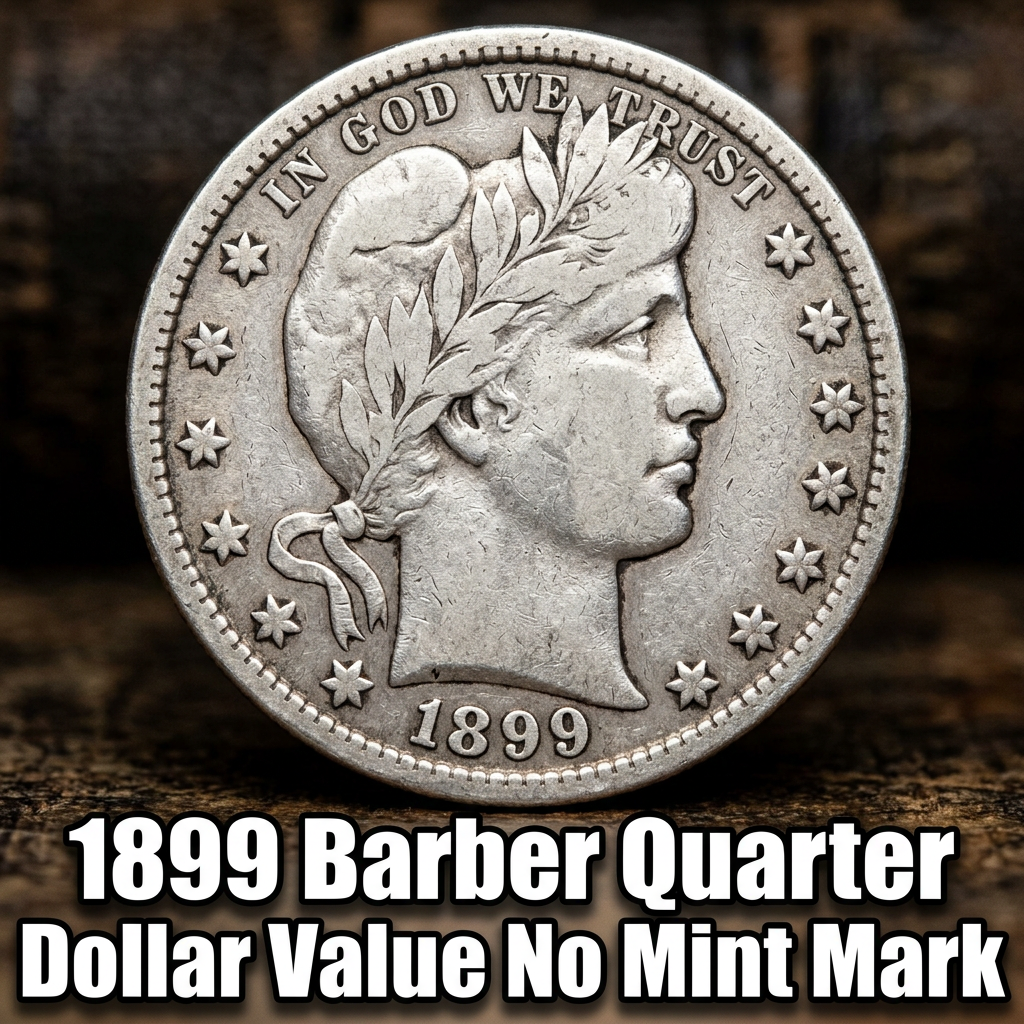
The 1899 Barber Quarter Dollar (Philadelphia Mint, no mint mark) is worth anywhere from $6 in heavily worn condition to over $400 in high-grade mint state examples. If you found one of these old silver coins in a drawer or inherited it from a relative, you’re sitting on something genuinely collectible — and this guide will help you understand exactly what it’s worth.
What Is the 1899 Barber Quarter and Why Does “No Mint Mark” Matter?
The 1899 Barber Quarter was struck at the Philadelphia Mint, which — true to long-standing U.S. Mint tradition — did not place a mint mark on its coins. So if you’re holding a 1899 quarter with Lady Liberty’s head on the front and no letter beneath the eagle on the reverse, you’ve got a Philadelphia issue. That’s actually the most common version of the 1899 quarter, with a mintage of around 12,624,000 pieces.
The coin was designed by Chief Engraver Charles E. Barber, which is why the series is nicknamed the “Barber coinage.” These quarters were minted from 1892 to 1916 and contain 90% silver — meaning even a worn example has real metal value backing it up.
If you want a quick way to identify the coin before diving into values, a coin identification app can help you confirm what you have using just your smartphone camera. Tools like these are a great first step for everyday collectors who aren’t sure where to start.
How Much Is the 1899 Barber Quarter Worth Today?
The value of the 1899 no mint mark Barber Quarter depends almost entirely on its condition, also called “grade” in collector terminology. A coin that’s been passed around in circulation for decades will be heavily worn and worth much less than one that was saved early and kept in good shape.
Here’s a general value breakdown based on condition:
| Grade / Condition | Estimated Value |
|---|---|
| Good (G-4) | $6 – $8 |
| Very Good (VG-8) | $10 – $14 |
| Fine (F-12) | $16 – $25 |
| Very Fine (VF-20) | $35 – $55 |
| Extremely Fine (EF-40) | $80 – $120 |
| About Uncirculated (AU-50) | $150 – $200 |
| Mint State (MS-60 to MS-65) | $250 – $425+ |
Keep in mind that silver prices fluctuate, which can slightly affect the baseline melt value of any 90% silver coin. CoinKnow tracks live silver prices alongside coin values, making it easy to know both what your coin is worth as a collectible and as raw metal.
How to Grade Your 1899 Barber Quarter at Home
You don’t need to be a professional numismatist to get a rough idea of your coin’s grade. Start by looking at the high points of the design — on the obverse, check Liberty’s hair above her ear and the lettering on her headband. On a Good-grade coin, “LIBERTY” on the band will be mostly worn away. On a Fine or better example, you should be able to read most of those letters clearly.
The reverse eagle’s breast feathers and the shield details are also important grade indicators. The sharper and more complete these details appear, the higher the grade — and the higher the value.
A good magnifying glass and a bright light source can go a long way. For a more confident assessment, consider using CoinKnow, which gives you grading guidance and estimated values in one place without needing to be an expert.
You can also check out detailed 1899 silver coin value information to better understand how silver-era coins from this period are priced across different grades and mint marks.
Is the 1899 No Mint Mark Barber Quarter Rare?
With over 12.6 million struck, the 1899 Philadelphia Barber Quarter isn’t considered rare by any stretch. But that doesn’t mean it’s easy to find in collectible condition. The vast majority of surviving examples are well-worn, having circulated heavily during the early 1900s. Finding one in Very Fine or better condition is genuinely exciting for a collector.
There are no major known varieties or errors for this date that command huge premiums, but a coin in MS-65 or above can still fetch several hundred dollars at auction. Proof versions were also struck for collectors in 1899 (around 846 pieces), and those are extremely valuable — often worth $1,000 or more.
If you’re unsure whether your coin might be a proof, look for razor-sharp detail, mirror-like fields, and frosted devices. CoinKnow can help you compare your coin’s characteristics side by side with reference images.
FAQ
Q: Does the 1899 Barber Quarter have any silver in it?
A: Yes. All Barber Quarters, including the 1899 no mint mark version, are made of 90% silver and 10% copper. Each coin contains approximately 0.1808 troy ounces of pure silver, giving it a melt value that moves with the silver market.
Q: How do I know if my 1899 quarter is from Philadelphia if there’s no mint mark?
A: The absence of a mint mark is actually the identifier for Philadelphia coins. If your 1899 Barber Quarter has no letter (no “O” for New Orleans, no “S” for San Francisco) below the eagle on the reverse, it was minted in Philadelphia.
Q: Is it worth getting my 1899 Barber Quarter professionally graded?
A: It depends on condition. If your coin looks like it’s in Extremely Fine or better shape, professional grading by PCGS or NGC could add significant credibility and value when selling. For heavily worn coins worth under $20, the grading fee likely isn’t justified.