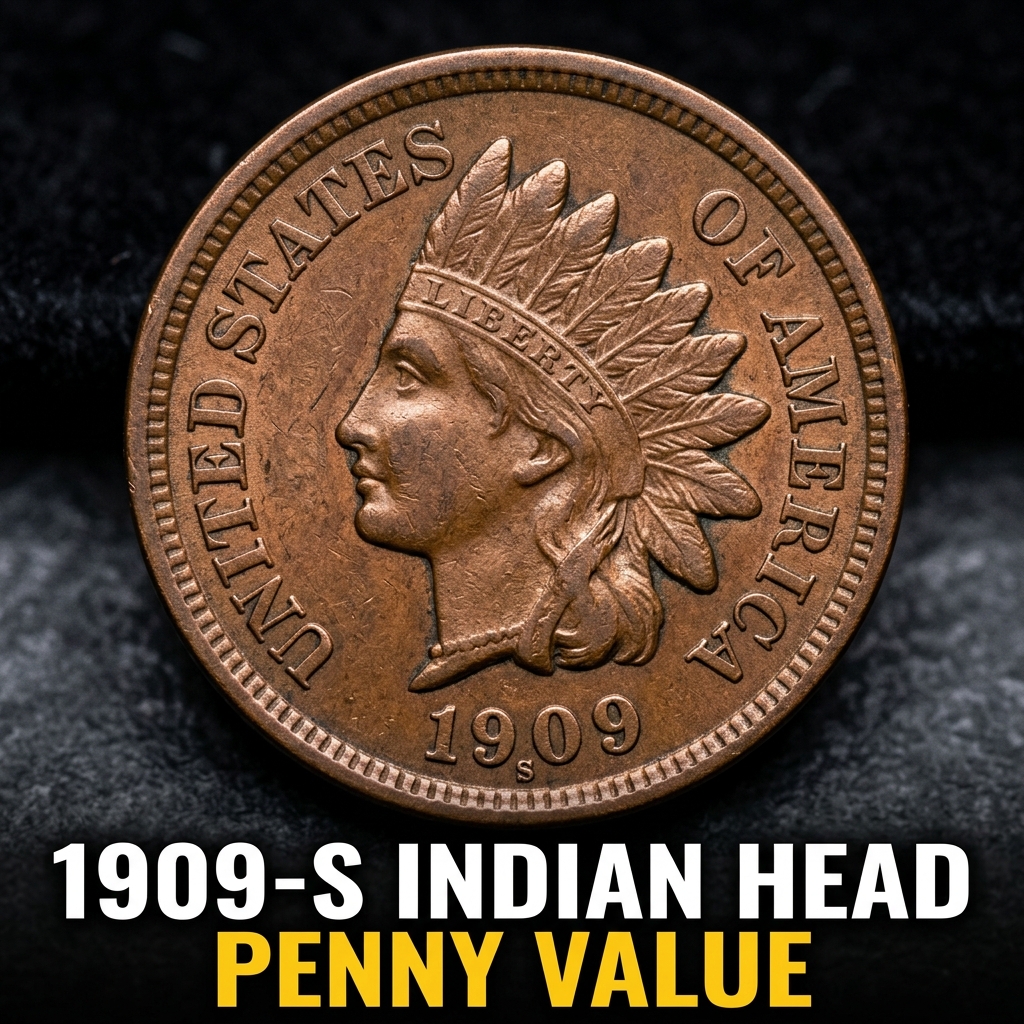
The 1909-S Indian Head Penny is worth anywhere from $300 in heavily worn condition to over $2,500 or more in mint state — making it one of the most valuable Indian Head cents a collector or everyday finder can come across. If you’ve got one in your hand right now, you’re holding something special.
Why the 1909-S Is So Valuable
The “S” mintmark on this coin tells a big story. It means the penny was struck at the San Francisco Mint, and in 1909, that facility produced only 309,000 Indian Head cents — a tiny number compared to the Philadelphia Mint’s output that same year. This was also the final year of the Indian Head Penny series, which had run since 1859. With low mintage numbers and a historic “last year of issue” status, demand from collectors has always been strong. The result is a coin that commands serious money even in poor shape.
If you’re not sure whether your coin has an “S” mintmark, look on the reverse (tails side) at the bottom, just beneath the wreath. A small “S” should be visible there. If you don’t see a mintmark at all, you likely have a Philadelphia issue, which is worth considerably less. Using a coin identification app can help you quickly verify the mintmark and other key details — especially useful if you’re new to coin collecting.
1909-S Indian Head Penny Value by Grade
Coin value is directly tied to condition, or “grade.” The better the coin looks, the more it’s worth. Here’s a general breakdown of what you might expect for a genuine 1909-S Indian Head Penny:
| Grade / Condition | Description | Estimated Value |
|---|---|---|
| Good (G-4) | Heavy wear, design visible | $300 – $400 |
| Fine (F-12) | Moderate wear, clear details | $450 – $600 |
| Extremely Fine (EF-40) | Light wear on high points | $700 – $950 |
| About Uncirculated (AU-55) | Slight wear, mostly sharp | $1,100 – $1,500 |
| Mint State (MS-63+) | No wear, original luster | $2,000 – $2,500+ |
For a closer look at current market prices for the 1909-S Indian Head Penny in mint red condition, it’s worth checking updated auction records, as values can shift with collector demand.
How to Tell If Your Coin Is Real
Because this coin is so valuable, counterfeits exist. Some fakes are made by adding an “S” mintmark to a common 1909 Philadelphia penny. A genuine 1909-S will have a mintmark that looks naturally integrated into the coin’s surface — not soldered or carved on top. If the “S” looks raised in an unusual way or has a different texture than the surrounding metal, be cautious.
Weight and diameter are also clues. A genuine Indian Head cent should weigh 3.11 grams and measure 19mm across. Having your coin professionally graded by PCGS or NGC is the best way to confirm authenticity and lock in its market value. CoinKnow is a handy tool that lets you scan and research coins from your phone before you take that step, giving you a solid baseline of what you’re working with.
What Affects the 1909-S Indian Head Penny Value Beyond Grade
Beyond the condition of the coin, a few other factors can push the value up or down. Color designation matters for higher-grade examples: coins graded Red (RD) are the most valuable because they retain their original copper color. Red-Brown (RB) coins are worth slightly less, and Brown (BN) examples trade at the lowest prices within mint state grades.
Strike quality also plays a role. Some 1909-S cents were weakly struck, particularly on the diamond shapes in the headband or on the feather tips. A sharply struck example will fetch a premium over a mushy one in the same grade.
Provenance can add value too — if your coin was once part of a well-known collection, that history can make it more desirable at auction. You can explore detailed value information for the 1909 Indian Head Penny to understand how these factors affect pricing across different grades and color designations.
Should You Sell, Hold, or Get It Graded?
If you’ve found or inherited a 1909-S Indian Head Penny, your next step depends on what you want to do with it. If you plan to sell, getting it professionally graded first almost always results in a higher selling price — buyers pay more for certified coins because the authenticity is guaranteed. If you’re curious about its value before committing to anything, CoinKnow lets you research comparable sales and get a rough idea of what the market is paying right now.
For coins in circulated grades, selling to a reputable coin dealer or listing on a major auction platform are both solid options. For higher-grade examples, major numismatic auction houses like Heritage Auctions or Stack’s Bowers can connect you with serious collectors willing to pay top dollar. Whatever you decide, don’t clean the coin — even a gentle wipe can scratch the surface and reduce the value significantly.
FAQ
Q: How do I know if my 1909 penny is the valuable “S” mintmark version?
A: Flip the coin over to the reverse side and look at the bottom of the design, just below the wreath. If you see a small “S,” it was made in San Francisco and is the rare, valuable version. No mintmark means it’s from Philadelphia and worth much less. CoinKnow can help you zoom in and identify the mintmark quickly.
Q: Is a worn 1909-S Indian Head Penny still worth money?
A: Absolutely. Even a heavily worn example in Good condition is typically worth $300 or more. The low mintage of just 309,000 coins means collectors still want them regardless of wear.
Q: Should I clean my 1909-S Indian Head Penny before selling it?
A: No — never clean an old coin. Cleaning causes microscopic scratches that professional graders can detect, and a “cleaned” designation will significantly lower the coin’s value compared to an unaltered example in the same condition.