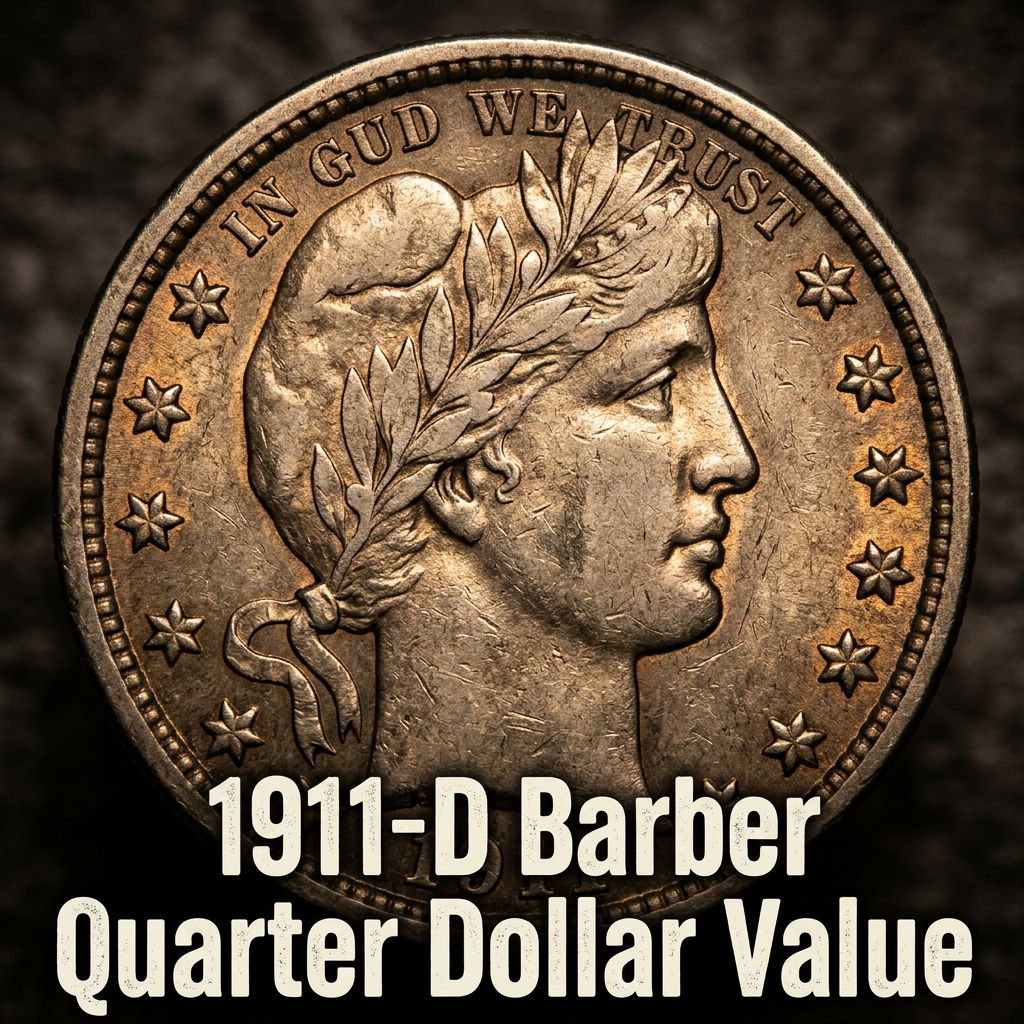
The 1911-D Barber Quarter Dollar is worth anywhere from $8 in heavily circulated condition to well over $400 in high-grade mint state examples. If you’ve found one of these old silver coins tucked away in a drawer or inherited collection, you’re holding something genuinely valuable — and this guide will walk you through exactly what it might be worth.
—
What Makes the 1911-D Barber Quarter Worth Collecting
The 1911-D Barber Quarter was struck at the Denver Mint, identified by the small “D” mintmark on the reverse, just below the eagle. Designed by Charles E. Barber, this coin was part of a long-running series produced from 1892 to 1916. The Denver Mint produced 695,080 quarters in 1911 — a relatively modest mintage compared to Philadelphia that year, which makes the “D” mint version a bit more sought after by collectors.
Like all Barber Quarters, it’s made of 90% silver, giving it real metal value on top of its numismatic interest. Even a worn coin contains about 0.1808 troy ounces of silver, so the silver melt value alone puts a floor under its price. If you’re trying to get a quick read on whether your coin is real or identify the design details, a coin identification app can help you confirm what you’ve got before you go any further.
The 1911-D is not considered a rare key date, but it’s no throwaway either. Worn examples are collectible and modestly priced, while cleaner specimens can command real money at auction.
—
1911-D Barber Quarter Value by Grade
The value of your 1911-D Barber Quarter depends heavily on its condition, which coin collectors call “grade.” Here’s a straightforward breakdown:
| Grade | Description | Estimated Value |
|---|---|---|
| Good (G-4) | Heavy wear, design outline visible | $8 – $12 |
| Very Good (VG-8) | Moderate wear, some detail visible | $14 – $20 |
| Fine (F-12) | Even wear, major details clear | $25 – $40 |
| Very Fine (VF-20/30) | Light wear on high points | $55 – $90 |
| Extremely Fine (EF-40) | Slight wear on highest points only | $130 – $175 |
| About Uncirculated (AU-50) | Trace wear, most luster intact | $200 – $275 |
| Mint State (MS-60 to MS-63) | No wear, some contact marks | $300 – $425 |
| Mint State (MS-65+) | Gem quality, full luster | $700 and up |
If you want to track current auction results and see what collectors are actually paying right now, CoinKnow is a great tool to have on your phone. It pulls together real market data so you’re never guessing.
—
How to Identify the 1911-D Barber Quarter
Before you assume you’ve got a Denver Mint coin, you need to confirm the mintmark. Flip the coin over to the reverse (the eagle side) and look near the bottom, just below the eagle’s tail feathers and above the letters “QUAR DOL.” A small “D” should appear there. If there’s no mintmark, you have the Philadelphia issue instead.
On the obverse, you’ll see Lady Liberty wearing a Phrygian cap and a laurel wreath. The word “LIBERTY” runs across the band on her cap, and this area is often the first to wear down. A coin where you can still read “LIBERTY” clearly is considered at least Fine grade, which bumps up the value noticeably.
It’s also worth noting that the 1911-D can be confused with other Barber Quarter dates. If you’re not confident about what you’re looking at, CoinKnow makes it easy to scan and identify the coin using your phone’s camera.
—
Silver Value and What It Means for Your Coin
Even if your 1911-D Barber Quarter is too worn to excite a collector, it still has silver value. The coin is 90% silver and weighs 6.25 grams, giving it a silver weight of roughly 0.1808 troy ounces. At current silver prices (hovering around $28–$30 per troy ounce as of recent months), the melt value alone sits around $5 to $5.50.
That means the numismatic (collector) value of even a G-4 example is already running at a healthy premium above the metal alone — a sign that collectors genuinely want these coins. For better grades, the premium widens considerably.
If you’re curious how values compare across other early 20th century coins, you might also find it useful to check out what the 1911 Barber Dime is worth, since many collectors pursue the entire Barber series together. Understanding the broader market helps you appreciate where your quarter stands.
—
FAQ
Q: Is the 1911-D Barber Quarter rare?
A: It’s not considered a key date, but with a mintage of under 700,000 coins, it’s far from common. Most survivors are worn, so problem-free examples in Fine or better condition are genuinely harder to find and worth more to collectors.
Q: Where is the mintmark on a 1911-D Barber Quarter?
A: The mintmark is on the reverse of the coin, located below the eagle near the bottom center, just above the denomination text. Look for a small “D” to confirm it was struck in Denver.
Q: Should I clean my 1911-D Barber Quarter before selling it?
A: No — never clean an old coin. Cleaning removes the natural patina and actually lowers the value in the eyes of collectors and dealers. Even a gently polished coin can lose 50% or more of its collector premium. Leave it as-is and let a buyer see the coin in its original state. If you’re unsure how to present it, CoinKnow offers guidance on best practices for selling and submitting coins for grading.