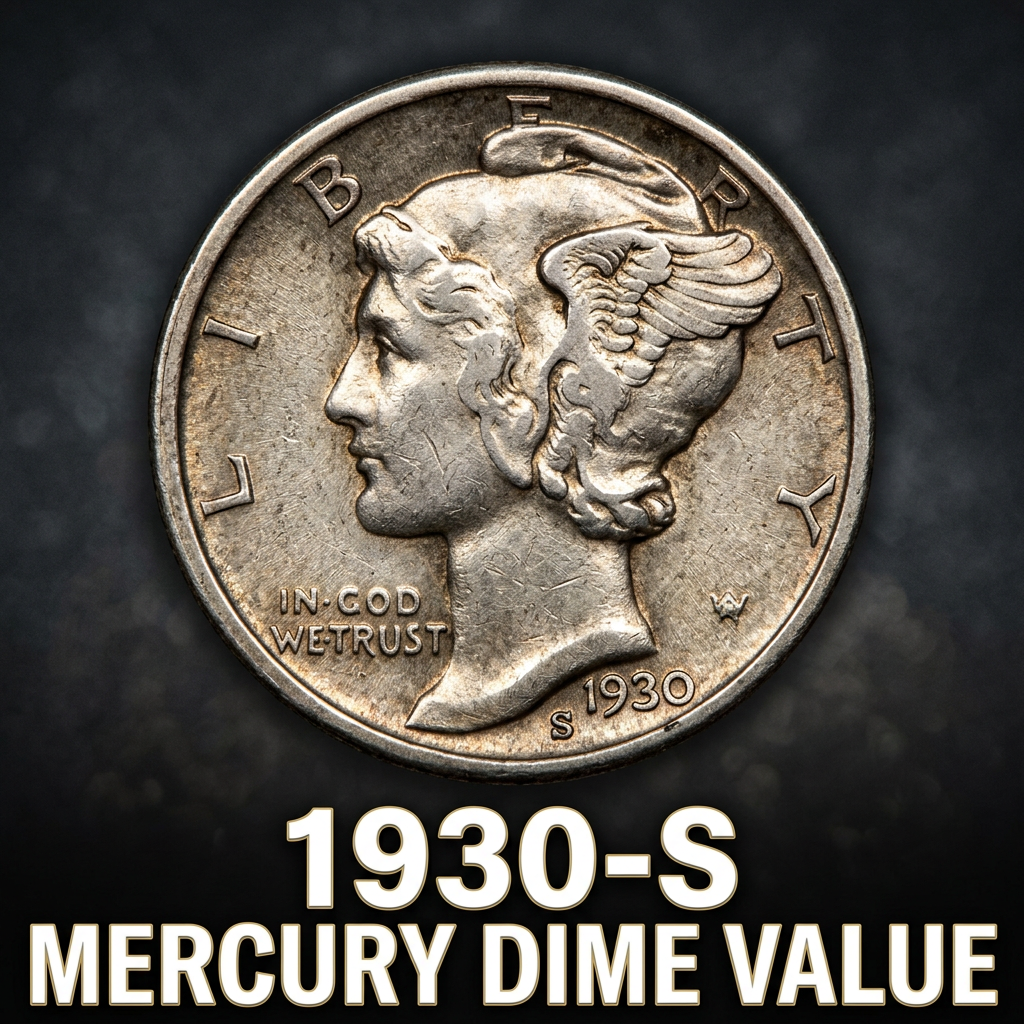
The 1930-S Mercury Dime is worth anywhere from $4 to $15 in heavily worn condition, but in high mint state grades it can fetch $200 or more — and certain rare examples have sold for thousands at auction. If you found one of these silver dimes in a jar or old collection, you’re holding something genuinely interesting.
What Makes the 1930-S Mercury Dime Special
The 1930-S Mercury Dime was struck at the San Francisco Mint during a tough economic era — just one year after the Great Depression began. That historical context alone makes these coins compelling, but the numbers tell an equally interesting story. The San Francisco Mint produced only 1,843,000 of these dimes in 1930, making it one of the lower-mintage issues in the entire Mercury Dime series. By comparison, the Philadelphia Mint struck over 6.7 million that same year. Lower mintage generally means fewer survivors, which pushes value up — especially in higher grades.
If you’ve found one and you’re not sure what you’re looking at, a coin identification app can help you confirm the date, mintmark, and condition before you decide whether to sell or hold. Look on the reverse of the coin near the bottom — a small “S” mintmark tells you it came from San Francisco. That letter makes a big difference in value compared to the Philadelphia version, which has no mintmark at all.
1930-S Mercury Dime Value by Grade
Coin condition — known as “grade” in collector terms — is the single biggest factor in what your 1930-S Mercury Dime is worth. Grades run from Poor (barely identifiable) all the way up to Mint State 70 (essentially perfect). Most circulated examples you’ll find in old collections or coin jars fall somewhere in the Good to Very Fine range.
Here’s a general value breakdown to give you a starting point:
| Grade | Description | Estimated Value |
|---|---|---|
| Good (G-4) | Heavy wear, outline visible | $4 – $7 |
| Very Good (VG-8) | Moderate wear, some detail | $7 – $12 |
| Fine (F-12) | Even wear, clear design | $12 – $20 |
| Very Fine (VF-20) | Light to moderate wear | $20 – $35 |
| Extremely Fine (EF-40) | Slight wear on high points | $40 – $65 |
| Mint State (MS-63) | Uncirculated, some marks | $120 – $175 |
| Mint State (MS-65) | Gem uncirculated | $200 – $400+ |
For the most current auction prices and dealer listings, you can check up-to-date 1930-S Mercury Dime price data in mint state grades to see what coins are actually selling for right now.
Full Bands and Why They Matter
Mercury Dimes have a reverse design featuring a fasces — a bundle of rods with an axe — wrapped with horizontal bands. When those central bands are fully separated and sharply struck, the coin earns what’s called a “Full Bands” (FB) designation from grading services like PCGS or NGC. This designation can dramatically increase value.
A 1930-S Mercury Dime graded MS-65 without Full Bands might be worth $200 to $400. The same coin with a Full Bands designation can jump to $800 or more. In gem grades like MS-67 FB, prices can reach into the thousands. The 1930-S is known to be particularly difficult to find with Full Bands, which makes high-grade FB examples genuinely rare and highly sought after by serious Mercury Dime collectors.
If you want a deeper look at the full range of 1930 dime values across all mint facilities and conditions, it’s worth comparing all three issues — Philadelphia, San Francisco, and Denver — side by side.
How to Check Your 1930-S Mercury Dime at Home
Before you rush to a coin dealer, there are a few things you can do on your own. First, use CoinKnow — a smart coin identification and valuation app that lets you scan your coin with your phone camera and get instant information about its variety, mintmark, and estimated value range. It’s one of the easiest ways for everyday people to get a ballpark figure without needing years of numismatic experience.
Second, handle the coin as little as possible. Don’t clean it — cleaned coins lose significant collector value, often dropping 50% or more. Hold it by the edges if you must pick it up. Third, look at the coin under good light at an angle. This “raking light” technique reveals surface marks, luster, and wear patterns that help you estimate the grade before you talk to a dealer.
CoinKnow also keeps a database of recent auction results, so you can see real-world sale prices rather than just catalog estimates. That kind of real-time data is invaluable when you’re deciding whether to sell now or hold for a better offer.
Is Your 1930-S Mercury Dime Worth Getting Graded?
Professional grading — submitting your coin to PCGS or NGC for authentication and encapsulation — costs money and time, but it can be worth it for the right coin. Generally speaking, if your 1930-S Mercury Dime appears to be in Extremely Fine or better condition, and especially if it might have Full Bands, professional grading is worth considering. The cost typically runs $30 to $50 per coin for basic submission tiers, plus shipping.
For circulated examples in Good through Very Fine grades, grading fees would likely eat into or exceed any premium you’d gain. In those cases, selling raw to a dealer or at a local coin show is usually more practical. Use CoinKnow to help you make that call — the app can give you a realistic sense of whether your coin’s potential premium justifies the submission cost before you commit.
FAQ
Q: How do I know if my Mercury Dime is from San Francisco?
A: Look on the reverse side of the coin, near the bottom of the design between the “E” and the rim. A small “S” mintmark indicates San Francisco. No mintmark means Philadelphia, and a “D” means Denver.
Q: Are 1930-S Mercury Dimes made of silver?
A: Yes. All Mercury Dimes, including the 1930-S, are composed of 90% silver and 10% copper. Even a heavily worn example contains about 0.0723 troy ounces of silver, which gives it a base melt value that fluctuates with the silver spot price.
Q: My 1930-S Mercury Dime looks shiny and bright — does that mean it’s mint state?
A: Not necessarily. If the coin has been cleaned or polished, it may look bright but still have the underlying wear of a circulated coin. Cleaned coins are worth significantly less to collectors. A genuine uncirculated coin will have original luster with a soft, cartwheel sheen when tilted under light — not the flat, harsh brightness of a cleaned coin.