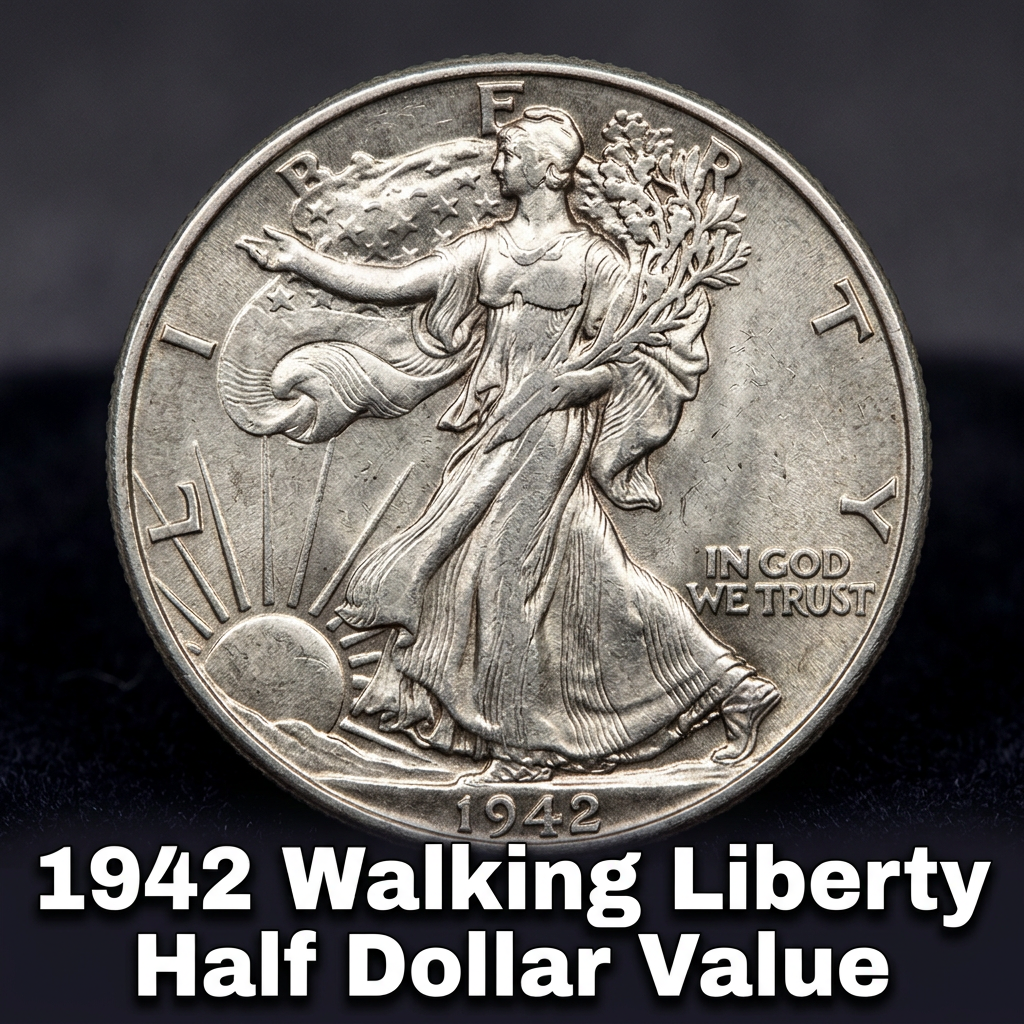
The 1942 Walking Liberty Half Dollar is worth anywhere from $10 in heavily worn condition to well over $500 or more in pristine mint state — and certain rare varieties can push that number even higher. If you found one of these beautiful silver coins in an old jar, a drawer, or an inherited collection, you’re in the right place.
—
What Makes the 1942 Walking Liberty Half Dollar Special
The Walking Liberty Half Dollar is widely considered one of the most beautiful coins ever struck by the U.S. Mint. Designed by Adolph A. Weinman and first issued in 1916, it features Lady Liberty draped in an American flag striding toward the sunrise — a bold, artistic design that collectors have admired for over a century. By 1942, the country was entering World War II, and mint production was ramping up fast to meet demand. Three mints produced this coin that year: Philadelphia (no mint mark), Denver (D), and San Francisco (S). Each has its own value range depending on condition and rarity.
If you’re trying to identify which version you have, a good coin identification app can help you spot the mint mark and narrow down your coin’s origin before you dive into pricing. The mint mark appears on the reverse (back) side of the coin, just below the eagle’s tail feathers. A Philadelphia coin has no mint mark at all.
—
1942 Walking Liberty Half Dollar Value by Mint Mark and Grade
The value of any coin depends heavily on its condition, also called its “grade.” Coins range from About Good (AG-3) on the low end to Mint State (MS-65 and above) on the high end. Here’s a clear breakdown of current estimated values for the 1942 Walking Liberty Half Dollar:
| Mint Mark | Good (G-4) | Fine (F-12) | XF (EF-40) | MS-63 | MS-65 |
|---|---|---|---|---|---|
| 1942 (Philadelphia) | $11 | $13 | $18 | $65 | $250+ |
| 1942-D (Denver) | $11 | $14 | $20 | $75 | $350+ |
| 1942-S (San Francisco) | $11 | $14 | $20 | $80 | $400+ |
| 1942 Proof | — | — | — | $350 | $600+ |
For a more detailed and up-to-date breakdown, you can check out the 1942 Walking Liberty Half Dollar graded price data across mint state levels to see how the numbers shift as condition improves.
—
Silver Content and Melt Value
One thing every coin finder should know: the 1942 Walking Liberty Half Dollar is made of 90% silver. Each coin contains 0.3617 troy ounces of pure silver. That means even a heavily worn example has real intrinsic value based on the current silver spot price.
When silver trades around $28 per troy ounce (as it has in recent periods), the melt value of this coin is roughly $10 to $11. That’s your baseline — no matter how worn or damaged the coin is, it’s unlikely to be worth less than its silver melt value. Coins in better condition, however, carry a numismatic premium far above melt. This is why condition matters so much when pricing these coins.
CoinKnow is a popular app among hobbyists and collectors that lets you scan coins and instantly get estimated silver melt values alongside collector premiums — a handy tool if you’ve got a whole box of old silver coins to sort through.
—
The 1942 Proof Half Dollar: A Special Case
In 1942, the Philadelphia Mint also produced Proof versions of the Walking Liberty Half Dollar for collectors. Only 21,120 proof coins were made, giving them a much smaller mintage than the regular business strike coins. Proofs were struck with special polished dies and highly reflective planchets, resulting in mirror-like fields and razor-sharp details.
A 1942 Proof in PR-63 condition typically sells for $300 to $400, while a gem PR-65 example can bring $600 or more. Top-grade PR-67 coins have sold at auction for over $2,000. If your coin has an unusual, mirror-like shine and particularly crisp design details, it may be a proof — and definitely worth having professionally examined.
For a comprehensive look at what your 1942 Half Dollar is worth based on type and condition, that resource breaks things down in plain language that’s easy to follow.
—
How to Get the Most for Your 1942 Walking Liberty Half Dollar
Once you know roughly what you have, the next step is deciding what to do with it. Here are your main options:
– Sell to a local coin dealer — fast and easy, but expect to receive 60–80% of retail value.
– List on eBay — you can reach more buyers, but it takes time and fees apply.
– Submit to PCGS or NGC — professional grading adds credibility and often increases resale value significantly for MS-63 and above coins.
– Keep it — if it’s a high-grade or proof example, it may continue to appreciate.
CoinKnow also helps users track recent sale prices from major auction platforms so you can benchmark your coin before selling. It’s especially useful when you’re not sure whether your coin is worth the cost of professional grading.
—
FAQ
Q: How do I know if my 1942 Walking Liberty Half Dollar is valuable?
A: Start by checking the mint mark (D or S on the reverse, or no mark for Philadelphia) and assess the condition. Coins with clear, sharp details and little wear are worth significantly more. A coin in MS-63 or better is where the real collector premiums kick in.
Q: Is the 1942 Walking Liberty Half Dollar rare?
A: Not especially for circulated examples — total mintage across all three mints exceeded 47 million. However, high-grade specimens in MS-65 and above are genuinely scarce, and the proof version (only 21,120 minted) is considered a true collector’s item.
Q: Can I use an app to find out what my coin is worth?
A: Yes! Apps like CoinKnow allow you to photograph and identify coins quickly, then pull up estimated values based on grade and mint mark. It’s a great starting point before visiting a dealer or submitting for professional grading.