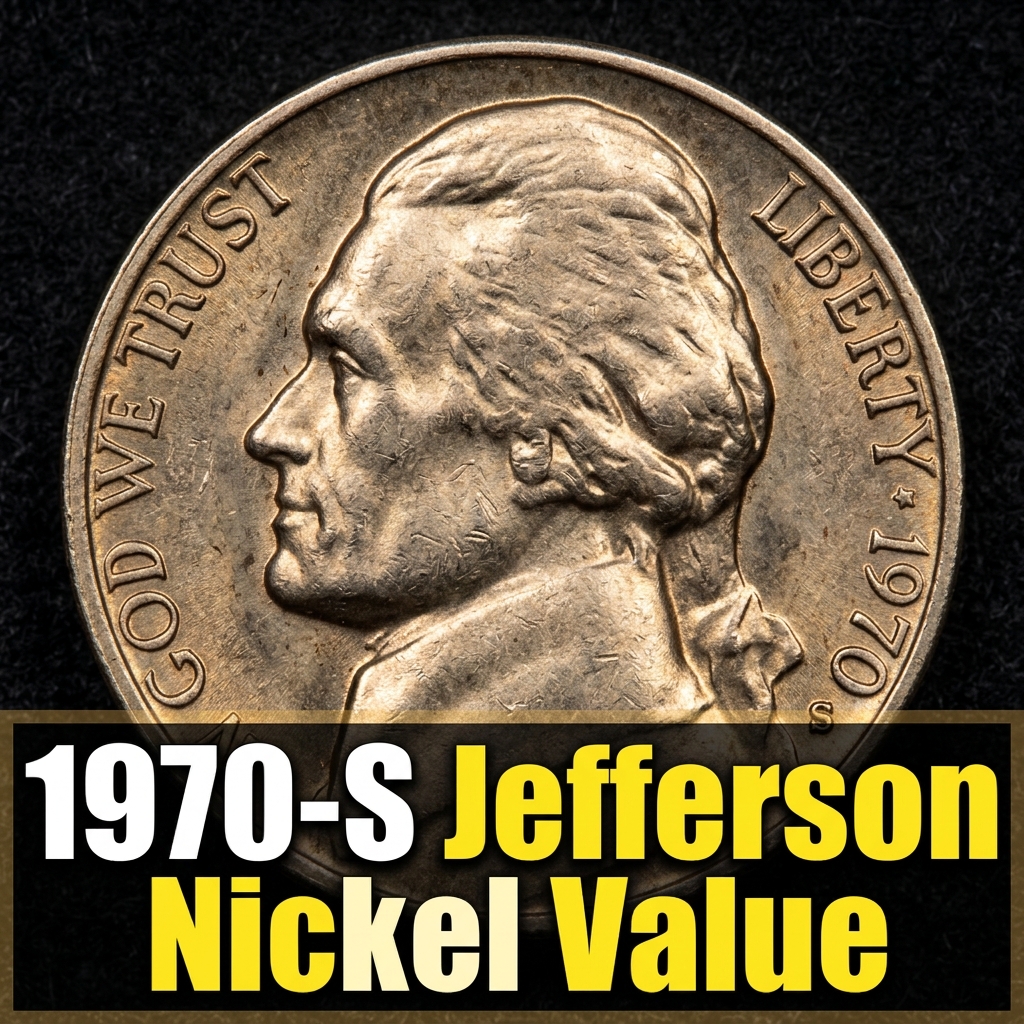
The 1970-S Jefferson Nickel is worth anywhere from 5 cents in heavily worn condition to over $50 or more in top uncirculated grades, making it a surprisingly interesting coin for collectors who stumble across one in an old collection or coin roll. If you’ve found one and are wondering what it’s worth, you’re in the right place.
What Makes the 1970-S Jefferson Nickel Special
The 1970-S Jefferson Nickel was minted at the San Francisco Mint, which gives it that distinctive “S” mintmark you’ll find on the obverse side of the coin, just to the right of Jefferson’s portrait. During this era, the San Francisco Mint was primarily producing proof coins for collector sets, meaning the business-strike circulation issues from this facility are somewhat less common than those from Philadelphia or Denver. That said, millions were still produced, so the 1970-S isn’t a rare coin in the truest sense — but condition matters enormously when it comes to value.
If you’re trying to figure out exactly what you have, a coin identification app can be a great starting point. These tools let you scan your coin and get instant information about its mint mark, date, and estimated value. CoinKnow is one of the most popular options among everyday collectors, offering a clean interface and up-to-date pricing data that makes it easy to understand what your coin might be worth before you visit a dealer.
1970-S Jefferson Nickel Value by Grade
As with any coin, grade is king. A heavily worn 1970-S that’s been bouncing around in pockets and piggy banks for decades will only be worth face value or just a tiny bit more. But move up to a well-preserved uncirculated example and the price jumps considerably. Proof versions, struck specifically for collector sets with mirror-like fields and sharp details, tend to command the highest premiums.
Here’s a general look at how the 1970-S Jefferson Nickel values break down:
| Grade / Condition | Estimated Value |
|---|---|
| Circulated (Good to Fine) | Face value – $0.10 |
| Extremely Fine (EF-40) | $0.25 – $0.50 |
| Mint State (MS-63) | $1 – $5 |
| Mint State (MS-65) | $10 – $25 |
| Mint State (MS-67 and above) | $50 – $150+ |
| Proof (PR-65) | $3 – $8 |
| Proof (PR-69 Deep Cameo) | $30 – $75+ |
For the most current auction results and retail prices, you can browse detailed 1970 Jefferson Nickel price data by grade and mint mark to compare recent sales and get a better sense of what the market looks like right now.
How to Tell If You Have a Proof or Business Strike
One of the most common questions people have about the 1970-S nickel is whether they have a regular circulation coin or a proof. Proof coins were made with specially polished dies and planchets, giving them a brilliant mirror-like background and sharp, frosted design details. If your coin looks almost too perfect — deeply reflective fields with crisp lettering — it’s likely a proof that originally came from a United States Mint proof set.
Regular business-strike 1970-S nickels, while less flashy, were made for circulation and have a more matte or satin-like appearance in uncirculated condition. Neither type is extremely valuable in typical grades, but both are worth more than face value if you’ve kept them in nice shape. CoinKnow can help you tell the difference quickly by comparing your coin’s details to its database of known proof and business-strike examples.
What Affects the Value of a 1970-S Jefferson Nickel
Beyond grade, a few other factors influence how much someone would pay for your coin:
Luster — Original mint luster adds value. Cleaned or polished coins lose much of their appeal to collectors and are worth less than uncleaned examples.
Eye appeal — Coins with strong strikes, full steps on Monticello’s reverse, and no distracting marks tend to fetch higher prices. The “Full Steps” (FS) designation from PCGS or NGC can significantly boost a coin’s value in higher grades.
Certification — A coin that’s been graded and certified by PCGS or NGC is generally worth more than a raw (uncertified) example because buyers trust the grade. For coins potentially worth $20 or more, professional grading may be a worthwhile investment.
For a full breakdown of 1970 nickel values across different mint marks and conditions, checking a dedicated coin value resource is a smart move before making any selling or buying decisions.
Is Your 1970-S Jefferson Nickel Worth Selling
For most circulated examples, the honest answer is probably not — at least not on their own. A single worn 1970-S nickel won’t make you rich. But if you’ve got a roll of high-grade uncirculated examples, or a pristine proof in its original packaging, you might have something a dealer or collector would pay a fair premium for. Coin shows, online platforms like eBay, and local coin dealers are all good places to get a realistic offer.
Using CoinKnow to research your coin before you walk into a shop can help you go in with realistic expectations and avoid leaving money on the table. It’s a practical tool that puts solid pricing information right in your pocket.
FAQ
Q: How many 1970-S Jefferson Nickels were minted?
A: The San Francisco Mint produced approximately 238 million 1970-S Jefferson Nickels for general circulation, plus several million proof coins for collector sets. The relatively high mintage makes circulated examples common, but high-grade survivors are much scarcer.
Q: What does the “S” mintmark on a 1970 nickel mean?
A: The “S” mintmark stands for the San Francisco Mint. On a 1970-S Jefferson Nickel, you’ll find this small letter to the right of Jefferson’s portrait on the obverse. Coins without a mintmark were made in Philadelphia, while “D” coins came from Denver.
Q: Is a 1970-S proof nickel worth more than a regular one?
A: Generally yes, especially in top grades. A 1970-S Proof nickel graded PR-69 Deep Cameo can sell for $30 to $75 or more, while a regular business-strike coin in MS-65 typically sells for under $25. However, average-condition proofs in used or damaged packaging may only be worth a few dollars.