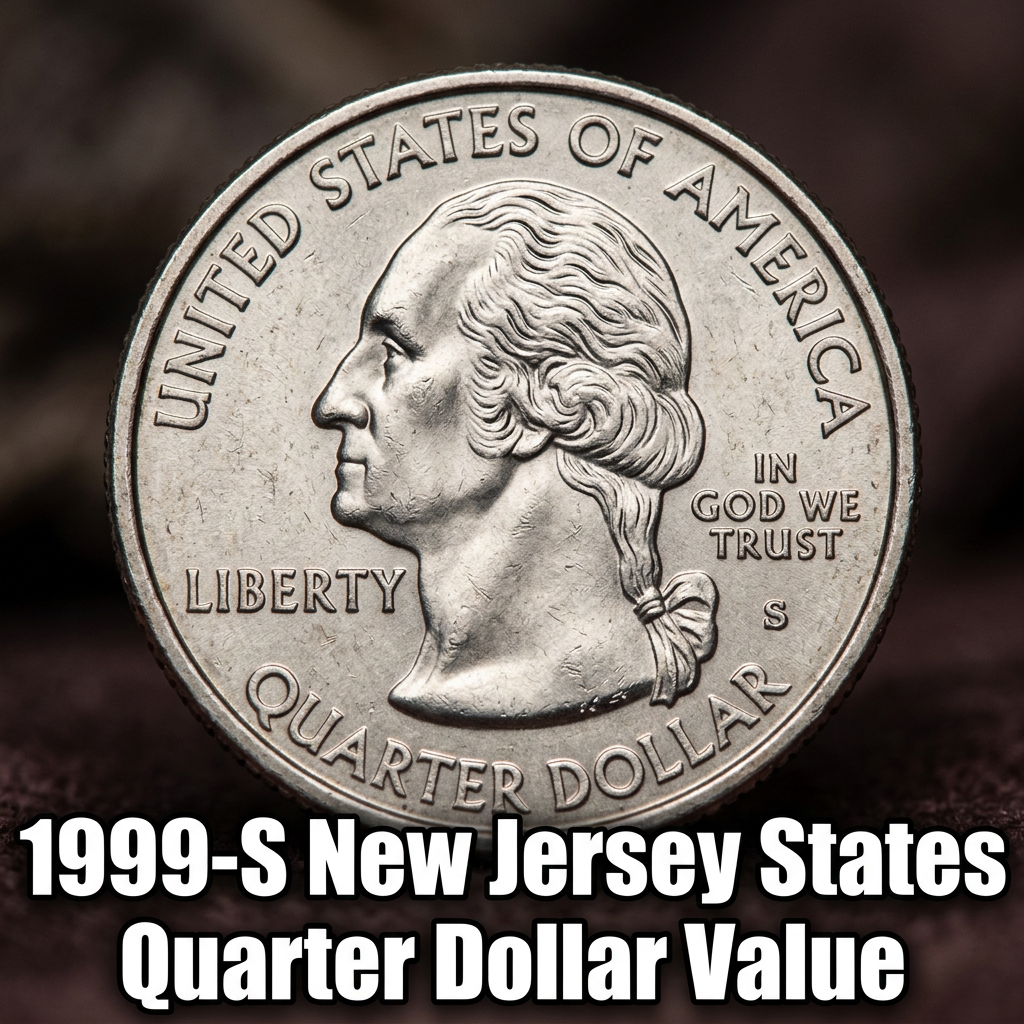
The 1999-S New Jersey State Quarter is worth anywhere from $1.50 in lightly circulated condition to over $10 or more for deep cameo proof examples — and a handful of error coins can fetch far higher prices. If you found one of these in a coin collection or old drawer, you’re in the right place to learn exactly what it’s worth.
What Is the 1999-S New Jersey State Quarter?
The 1999-S New Jersey State Quarter was struck at the San Francisco Mint and is part of the historic 50 State Quarters Program launched by the U.S. Mint in 1999. Unlike the Philadelphia (P) and Denver (D) mint versions intended for everyday circulation, the “S” mintmark means this coin was produced exclusively as a proof coin — meaning it was struck with specially polished dies and planchets to create a sharp, mirror-like finish for collectors.
The reverse design features George Washington crossing the Delaware River on December 25, 1776, a moment central to New Jersey’s Revolutionary War history. The obverse carries the standard portrait of George Washington. These coins were sold in proof sets directly by the U.S. Mint and were never intended to circulate in everyday commerce.
If you want to identify whether your coin is a proof or a standard issue, a coin identification app can help you examine key details like mintmark placement, surface finish, and edge characteristics right from your phone. Tools like CoinKnow are especially handy for beginners who want a fast, reliable answer without needing to visit a coin dealer.
1999-S New Jersey Quarter Value by Grade and Type
The value of the 1999-S New Jersey Quarter depends heavily on its condition and whether it’s a standard proof or a deep cameo proof. Here’s a simple breakdown:
| Grade / Type | Estimated Value |
|---|---|
| Proof PR65 | $1.50 – $3.00 |
| Proof PR67 | $4.00 – $6.00 |
| Proof PR69 Deep Cameo (DCAM) | $8.00 – $15.00 |
| Proof PR70 Deep Cameo (DCAM) | $20.00 – $50.00+ |
| Error Coins (varies) | $50.00 – $200.00+ |
Most 1999-S New Jersey quarters you’ll encounter fall in the PR65 to PR69 DCAM range. The difference between a PR69 and a PR70 might look minimal to the naked eye, but it can mean a significant jump in collector value. If you’re curious how your specific coin compares to recent auction results, you can browse detailed 1999 quarter value data including proof and mint state examples to see where your coin stands in today’s market.
How Mintage Numbers Affect the 1999-S New Jersey Quarter’s Worth
The San Francisco Mint produced approximately 3,713,359 proof 1999-S New Jersey State Quarters. That number sounds large, but compared to the hundreds of millions of circulation strikes made in Philadelphia and Denver, it’s actually quite modest. Fewer coins in existence generally means stronger collector demand over time.
It’s also worth noting that not all of these proof coins survived in perfect condition. Many were handled carelessly, improperly stored, or removed from their original proof sets — reducing the number of high-grade examples that remain today. If yours is still sealed in its original U.S. Mint proof set packaging, that’s a good sign it’s in top condition.
For comparison, if you’re also curious about the circulation versions from the same year, pricing data for the 1999-P Delaware State Quarter in MS grades gives you a useful benchmark to understand how mint state values differ from proof coins in the same program.
Errors and Varieties That Can Dramatically Increase Value
Error coins are where things get exciting. The 1999-S New Jersey State Quarter has a few known varieties and errors that collectors actively seek out. These include:
– Die cracks and cuds — raised lines on the coin’s surface caused by a cracked die during minting
– Doubled die errors — slight doubling of design elements visible under magnification
– Off-center strikes — the design is visibly misaligned from center
Even a minor error can push the value of an otherwise ordinary coin into the $50–$200 range or higher if the error is dramatic and well-documented. Apps like CoinKnow make it easier to spot these anomalies by guiding you through a visual checklist of common error types so you can flag anything unusual before taking the coin to a dealer.
Should You Get Your 1999-S New Jersey Quarter Graded?
Professional grading through services like PCGS or NGC is worth considering if you believe your coin is a PR69 DCAM or higher. Grading fees typically start around $20–$30, so it only makes financial sense if the coin’s potential value exceeds that cost. A certified PR70 DCAM example, for instance, is far easier to sell — and at a higher price — than an ungraded coin of the same quality.
If you’re unsure where to start, CoinKnow offers a guided valuation process that helps you assess whether professional grading is worth the investment before you commit to spending money on submission fees.
FAQ
Q: Is the 1999-S New Jersey Quarter rare?
A: It’s not considered rare in absolute terms, but with just over 3.7 million minted — all as proofs — it’s significantly scarcer than the circulation versions. High-grade DCAM examples are harder to find and do carry a collector premium.
Q: Can I find the 1999-S New Jersey Quarter in pocket change?
A: Very unlikely. The “S” mint proof coins were sold directly in collector sets and were never released into general circulation. If you find a New Jersey quarter in change, it will have either a “P” or “D” mintmark.
Q: What’s the best way to find out exactly what my 1999-S New Jersey Quarter is worth today?
A: Start by checking the mintmark and surface quality. Then compare your coin to recent sales data online. Using a tool like CoinKnow can give you a fast starting estimate, and for high-grade examples, consider submitting to PCGS or NGC for official certification.