The 2007 James Madison Presidential Dollar is worth anywhere from $1 in circulated condition to $10 or more in pristine uncirculated grades, with certain error coins fetching hundreds of dollars. If you found one of these golden-colored dollars in your change drawer or an old collection, you’re in the right place — let’s break down exactly what it’s worth.
What Is the 2007 Madison Dollar Coin?
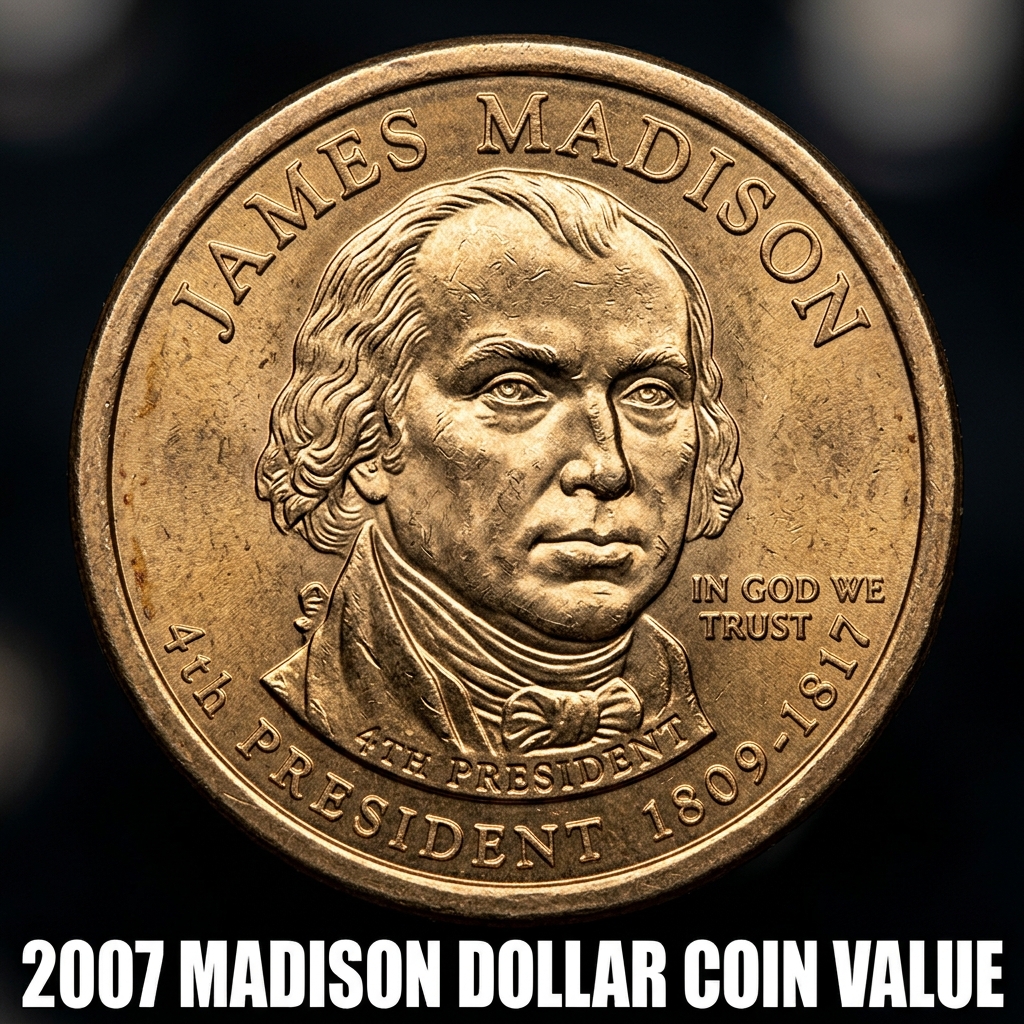
The James Madison Dollar was released in 2007 as part of the Presidential Dollar series, which was launched by the U.S. Mint to honor former presidents in the order they served. Madison, the fourth president and a key architect of the U.S. Constitution, was featured on one of the four coins released that year alongside Washington, Adams, and Jefferson. If you’re not sure which coin you’re holding, a coin identification app can help you confirm the design and mint mark quickly. The coins are golden in color thanks to a manganese-brass composition, and they measure 26.5mm in diameter — the same size as a modern dollar coin. On the obverse, you’ll see Madison’s portrait along with his years in office (1809–1817). The reverse features the Statue of Liberty. These were minted in Philadelphia (P) and Denver (D), and a small number were struck at San Francisco (S) as collector proof coins.
2007 Madison Dollar Value by Grade and Mint Mark
Most 2007 Madison Dollars you’ll come across are worth face value or just slightly above it — about $1 to $3 in circulated condition. The real value jumps when the coin is uncirculated, especially in higher Mint State (MS) grades. Here’s a quick look at approximate values:
| Coin | Circulated | MS63 | MS65 | MS67+ |
|---|---|---|---|---|
| 2007-P Madison Dollar | $1–$2 | $2–$4 | $5–$8 | $30–$100+ |
| 2007-D Madison Dollar | $1–$2 | $2–$4 | $5–$8 | $30–$100+ |
| 2007-S Proof Madison Dollar | N/A | $8–$12 | $12–$20 | $25–$50+ |
For a more detailed breakdown of 2007 Presidential Dollar values across all grades and mint marks, it’s worth bookmarking a reliable pricing resource so you can track market changes over time.
The Valuable Error Coins You Should Look For
Here’s where things get really interesting. A subset of 2007 Presidential Dollars — including the Madison — were struck without the edge lettering. Normally, these coins have “E PLURIBUS UNUM,” “IN GOD WE TRUST,” the mint mark, and the year inscribed on the edge. When those inscriptions are missing entirely, you’ve got what collectors call a “Godless Dollar” or plain-edge error. These errors can be worth anywhere from $50 to $300 or more depending on condition and demand. There are also partial-edge lettering errors and doubled-edge lettering errors that carry premiums. If your coin looks like it might have an edge error, don’t clean it — that can drastically reduce its value. Instead, grab CoinKnow to photograph and analyze your coin’s details before making any decisions about selling or grading. Even minor die varieties can make a big difference in what a collector is willing to pay.
How Condition Affects the 2007 Madison Dollar Price
Coin grading might sound intimidating, but you don’t need to be an expert to get a general sense of your coin’s condition. A circulated coin will show signs of wear — the high points of Madison’s portrait will look flat or dull, and the luster (that original shine) will be mostly gone. An uncirculated coin, sometimes called “BU” or “Brilliant Uncirculated,” will still have its original mint luster and sharp details. The highest grades (MS67, MS68) are almost flawless and command the biggest premiums. One helpful tip: compare your coin to graded examples online. CoinKnow makes this easy by letting you scan your coin and compare it against a library of graded examples so you can estimate where it might fall on the Sheldon scale before sending it to a grading service like PCGS or NGC.
Where to Sell or Get More Information
Once you know what you have, you’ll want to figure out the best way to sell it — or whether to hold onto it. For common circulated examples, eBay and coin dealer buyouts are your most practical options, though you’ll typically get face value or just a dollar or two above it. Error coins and high-grade specimens should go through a professional grading service first — a PCGS or NGC holder can significantly increase buyer confidence and final sale price. You can also check current auction price data for 2007-P dollars in MS grades to see what similar coins have actually sold for recently. That real-world sales data is far more useful than estimated price guides alone.
FAQ
Q: Is the 2007 Madison Dollar made of silver?
A: No. The 2007 James Madison Dollar is made of a manganese-brass alloy, which gives it that distinctive golden color. It contains no silver or gold. Only the proof versions issued for collectors in special sets have any precious metal content — and even those are standard clad composition.
Q: What makes the 2007 Madison “Godless Dollar” so valuable?
A: The edge-lettering errors — where “IN GOD WE TRUST” and other inscriptions are missing — were caused by a production glitch early in the Presidential Dollar series. These coins slipped past quality control and entered circulation, making them a genuine mint error. Collectors prize errors like these, which is why they can sell for 50 to 300 times face value depending on condition.
Q: How can I tell if my 2007 Madison Dollar has an error?
A: Roll the coin gently between your fingers and examine the edge carefully. If the edge is smooth and blank with no lettering at all, you likely have a plain-edge error. If the lettering appears doubled or upside down, that’s another variety worth researching. Use CoinKnow to document your findings and compare with known error examples before reaching out to a coin dealer or grading service.