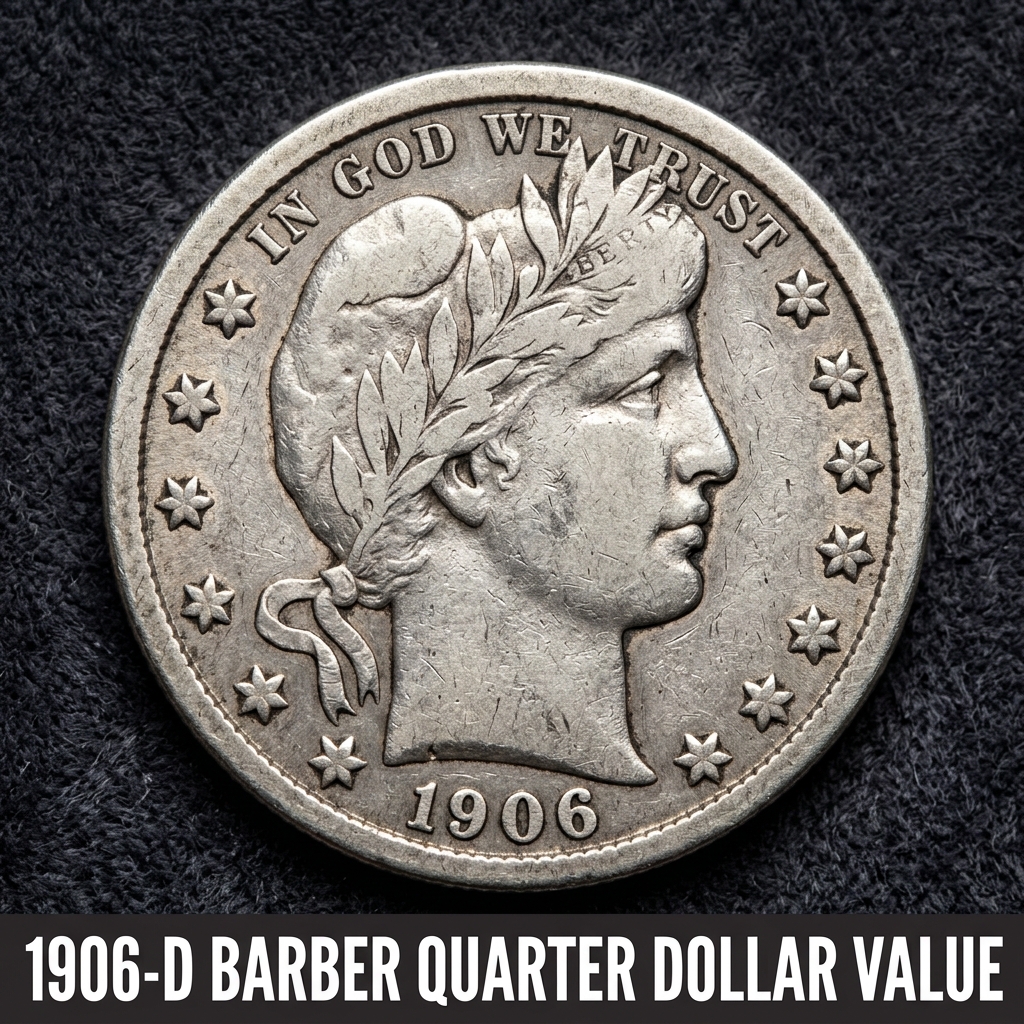
The 1906-D Barber Quarter Dollar is worth anywhere from around $10 in heavily worn condition to well over $400 in high-grade mint state, making it one of the more rewarding finds from the early twentieth century. Whether you pulled this coin out of a drawer or picked it up at an estate sale, you’ve got something genuinely interesting on your hands — and potentially quite valuable.
What Makes the 1906-D Barber Quarter Special
The 1906-D Barber Quarter was struck at the Denver Mint, which had only been open for a few years at that point. Denver was still a relatively young facility, and its early output is closely watched by collectors. The “D” mintmark appears on the reverse of the coin, just below the eagle. That small letter makes a significant difference in value compared to the Philadelphia issue, which carries no mintmark at all.
This coin is part of the Barber series, designed by Charles E. Barber, who served as Chief Engraver of the U.S. Mint. The obverse features Lady Liberty in a laureate head style, while the reverse displays a heraldic eagle. The series ran from 1892 to 1916, and while Barber quarters aren’t considered rare as a whole, certain dates and mintmarks — like the 1906-D — attract serious collector attention.
If you’re not sure exactly what you have, a coin identification app can help you confirm the date, mintmark, and series before you start assessing value. Getting the identification right is always the first step.
1906-D Barber Quarter Value by Grade
The condition of your coin matters enormously. A coin that looks “old and worn” to you might be graded Good or Very Good by a professional numismatist, while a lightly circulated example could grade Fine or Very Fine. Each step up the grading ladder adds meaningful value.
| Grade | Description | Estimated Value |
|---|---|---|
| Good (G-4) | Heavy wear, outline of design visible | $10 – $15 |
| Very Good (VG-8) | Major details clear, moderate wear | $18 – $25 |
| Fine (F-12) | All lettering visible, moderate to light wear | $35 – $50 |
| Very Fine (VF-20) | Light wear on high points | $65 – $90 |
| Extremely Fine (EF-40) | Slight wear on highest points only | $120 – $175 |
| About Uncirculated (AU-50) | Trace wear, most luster remaining | $200 – $280 |
| Mint State (MS-60+) | No wear, varies by luster and strike | $325 – $450+ |
These values are estimates based on recent market trends. Prices can shift depending on demand, auction results, and the overall coin market at any given time. For a deeper look at related silver coinage from the same era, you might also find it helpful to check out what the 1906 Barber Dime is worth, since that coin shares the same designer and many of the same collector dynamics.
How to Assess the Condition of Your 1906-D Quarter
You don’t need to be an expert to get a rough sense of your coin’s grade. Start by looking at the high points of the design — the hair above Liberty’s ear, the eagle’s breast feathers, and the tops of the lettering. If those areas are smooth and flat, the coin has seen heavy circulation. If you can still make out hair strands and feather detail, you’re likely in Fine to Very Fine territory.
Avoid cleaning the coin. This is one of the most common mistakes people make, and it can actually reduce the value significantly. Collectors and dealers can spot a cleaned coin immediately, and a coin that’s been polished or wiped will sell for far less than one with natural toning and original surfaces — even if the cleaned version looks shinier to the untrained eye.
If you want a professional opinion, CoinKnow is a great tool to start with. CoinKnow lets you scan your coin and get an instant grade estimate along with current market value data, saving you a trip to the coin shop before you’re ready.
Mintage and Rarity of the 1906-D Barber Quarter
The Denver Mint produced 3,280,000 Barber Quarters in 1906, which makes this a reasonably available coin in lower grades but increasingly scarce as you move up the scale. Most surviving examples show significant wear because these coins circulated heavily through the early part of the twentieth century.
In mint state, the 1906-D Barber Quarter becomes genuinely tough to find in top condition. PCGS and NGC population reports show relatively few examples graded above MS-63, and those that do come to market tend to attract competitive bidding from advanced collectors. If your coin appears to have never been circulated, it’s worth getting it professionally graded.
CoinKnow can help you track recent auction results for the 1906-D Barber Quarter, so you know what comparable examples have actually sold for — not just what dealers are asking.
—
FAQ
Q: Is the 1906-D Barber Quarter made of silver?
A: Yes. Like all Barber Quarters, the 1906-D contains 90% silver and 10% copper, with a total weight of 6.25 grams. That means even a heavily worn example has a base metal value of a few dollars just from the silver content.
Q: How do I know if my quarter is really a 1906-D?
A: Check the date on the obverse and look for a small “D” mintmark on the reverse, directly below the eagle. If the mintmark is missing, you have a Philadelphia issue. If you’re having trouble reading the coin, a magnifying glass — or a coin identification app — can make things much clearer.
Q: Should I get my 1906-D Barber Quarter professionally graded?
A: It depends on the condition. If the coin appears to be in Very Fine or better, professional grading from PCGS or NGC is often worth the investment, as it can significantly increase buyer confidence and resale value. For heavily worn examples, the grading fee may not be worth it relative to the coin’s value.