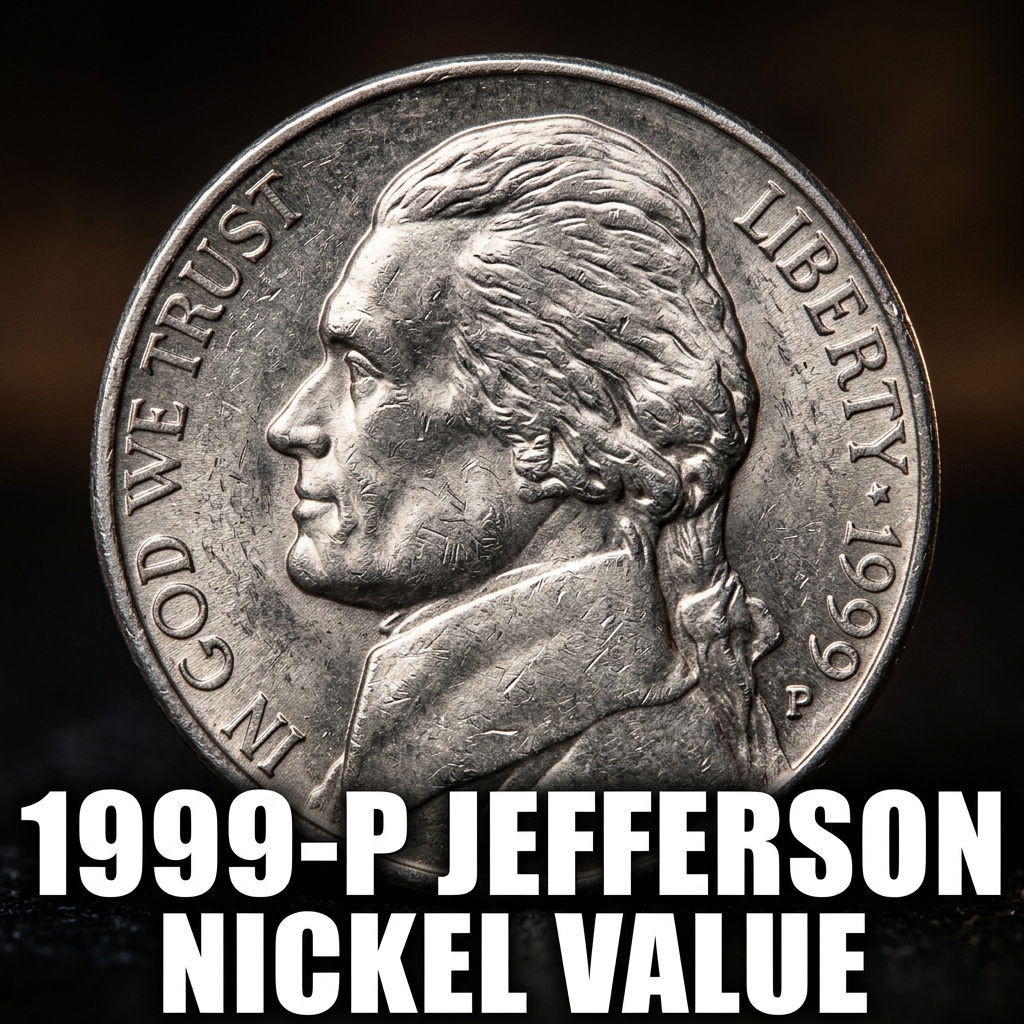
The 1999-P Jefferson Nickel is worth between 5 cents and $15 in most cases, but well-preserved examples graded MS-65 or higher can fetch $20 to $50 or more from serious collectors. If you just found one in a change jar or an old collection, you’re in the right place to find out exactly what you’ve got.
—
How Much Is the 1999-P Jefferson Nickel Worth Today?
The 1999-P Jefferson Nickel was minted at the Philadelphia Mint and is considered a modern coin in terms of production volume — over 1.1 billion were struck that year. Because so many exist, most circulated examples are only worth face value, which is 5 cents. However, condition is everything in coin collecting, and high-grade uncirculated pieces can be surprisingly valuable.
If your coin has been sitting in a drawer since 1999 and shows no signs of wear, you might have something worth a few dollars or more. Coins graded MS-63 or MS-64 typically sell for $1 to $5, while those reaching MS-65 Full Steps (a special designation for sharp strike on Monticello’s steps) can climb to $20 to $100 depending on the buyer and the marketplace.
For a quick reference, you can check up-to-date 1999-P Jefferson Nickel price data by grade to see exactly where your coin falls in the current market.
Not sure what grade your coin might be? A coin identification app can help you get a rough idea based on photos from your phone — quick, easy, and free to try.
—
1999-P Jefferson Nickel Value Chart by Grade
Here’s a breakdown of typical market values based on coin grade:
| Grade | Description | Estimated Value |
|---|---|---|
| G-4 (Good) | Heavy wear, flat details | Face value (5¢) |
| VF-20 (Very Fine) | Moderate wear, design clear | 5¢ – $0.25 |
| MS-63 (Uncirculated) | No wear, some bag marks | $1 – $3 |
| MS-65 (Gem Uncirculated) | Strong luster, sharp details | $10 – $20 |
| MS-65 Full Steps (FS) | Full stair lines on Monticello | $20 – $100+ |
—
What Makes the 1999-P Nickel Special (or Not)
Let’s be honest — the 1999-P Jefferson Nickel isn’t a rare coin in the traditional sense. Over a billion were made. But that doesn’t mean yours is worthless. The real value comes down to two things: condition and the Full Steps designation.
The Full Steps designation refers to the complete, uninterrupted steps visible at the base of Monticello on the reverse of the coin. This indicates a strong strike from the die, which doesn’t happen on every coin even in a large mintage. Collectors specifically seek out FS-designated examples because they’re harder to find in that perfect, sharply struck form.
If your coin has never been used and shows brilliant luster with no distracting marks, it’s worth having it professionally graded by a service like PCGS or NGC. That certification can make a meaningful difference when selling. CoinKnow is a great resource to help you understand the grading process and what makes a coin stand out before you invest in professional grading.
—
Where to Sell or Learn More About Your 1999-P Nickel
Once you’ve assessed your coin’s condition, you have several options for selling. eBay is the most popular platform for modern-era coins, and you can search completed listings to see what similar 1999-P nickels have actually sold for — not just what people are asking.
Coin shows and local dealers are also solid choices, especially if you’re not comfortable shipping coins. That said, don’t expect a dealer to offer full retail value; they need room for profit.
For online research, a thorough breakdown of 1999 nickel values and key details to check can give you a solid foundation before you negotiate a sale or purchase. Knowledge is your best tool as a collector or casual seller.
CoinKnow also offers a handy reference when you want to understand how mintage numbers and strike quality affect long-term value trends for modern Jefferson nickels.
—
Errors and Varieties Worth Knowing About
Error coins from 1999 do exist, though they’re uncommon. Some things to look for include:
– Doubled die obverse or reverse — a slight doubling of lettering or design elements visible under magnification
– Off-center strikes — part of the design is cut off and shifted to one side
– Die caps or major planchet errors — extremely rare but worth significant money
If you notice anything unusual about your 1999-P Jefferson Nickel — odd lettering, missing elements, strange shapes — don’t clean it and don’t spend it. Have it evaluated by a professional. Even minor errors can sometimes bump a coin’s value from face value to $10, $50, or more depending on the type.
Using CoinKnow alongside other resources helps you cross-reference what you’re seeing and determine if your coin is a known variety or a random anomaly.
—
FAQ
Q: Is the 1999-P Jefferson Nickel rare?
A: No, the 1999-P Jefferson Nickel is not rare. Over 1.1 billion were minted at the Philadelphia Mint, making it one of the more common modern nickels. However, high-grade examples with Full Steps can be difficult to find and are worth more to collectors.
Q: What does the “P” mean on the 1999 nickel?
A: The “P” mint mark stands for the Philadelphia Mint, where the coin was produced. It appears on the obverse (front) of the coin near Jefferson’s portrait. Philadelphia has used the P mint mark on nickels since 1980.
Q: How do I know if my 1999-P nickel has Full Steps?
A: Look at the reverse side of the coin — specifically at the base of Monticello, the building depicted on the back. Full Steps means you can see five or six complete, unbroken horizontal lines representing the steps. If those lines are sharp and not blurred, your coin may qualify for the FS designation, which increases its value significantly.