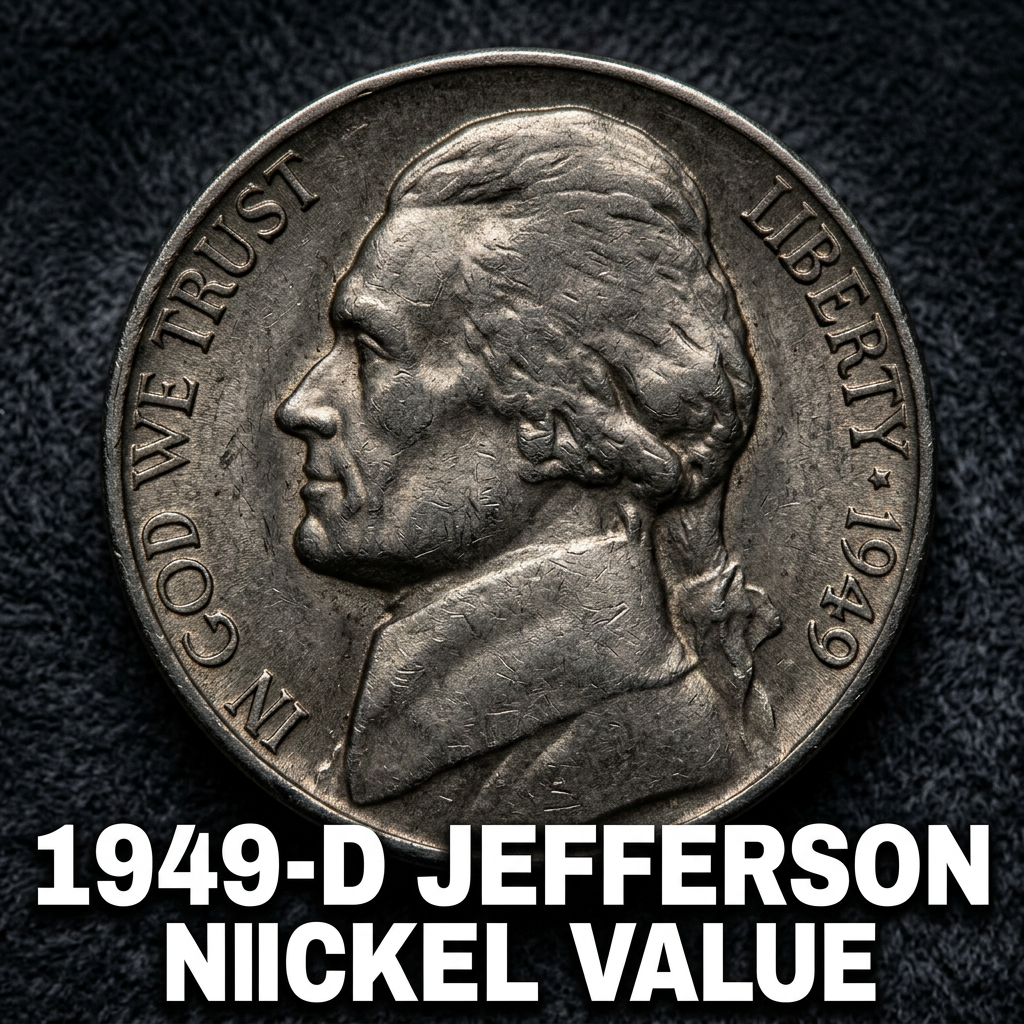
The 1949-D Jefferson Nickel is worth anywhere from about $0.25 in heavily worn condition to over $100 or more in top-tier mint state grades. If you found one of these coins in a jar, a drawer, or an old collection, you’re in the right place to find out exactly what it’s worth.
What Makes the 1949-D Jefferson Nickel Special
The “D” mintmark on a 1949 Jefferson Nickel tells you it was struck at the Denver Mint. This is actually one of the more interesting issues from the late 1940s Jefferson series. The Denver Mint produced around 36.5 million nickels in 1949, which sounds like a lot — but finding one in truly sharp, uncirculated condition is harder than you’d expect. Most of these coins spent decades passing through hands, vending machines, and piggy banks, leaving them well-worn by today.
If you’re trying to figure out exactly what you have, a coin identification app can help you confirm the mint mark, date, and grade range before you get too excited or sell too low. The mintmark is located on the reverse of the coin, to the right of Monticello. Look closely — it’s a small letter “D.”
1949-D Jefferson Nickel Value by Grade
Coin value is almost entirely tied to condition, or “grade.” A nickel fresh from circulation looks completely different from one that was set aside in a collection 75 years ago. Here’s a general breakdown of what the 1949-D Jefferson Nickel is worth across different grade levels:
| Grade | Description | Estimated Value |
|---|---|---|
| Good (G-4) | Heavy wear, outline visible | $0.25 – $0.50 |
| Fine (F-12) | Moderate wear, some detail | $0.50 – $1.00 |
| Extremely Fine (EF-40) | Light wear on high points | $1.50 – $4.00 |
| About Uncirculated (AU-55) | Slight friction, mostly sharp | $5 – $12 |
| Mint State (MS-63) | Uncirculated, minor marks | $15 – $35 |
| Mint State (MS-66+) | Near-perfect, gem quality | $75 – $150+ |
For the most current pricing data, you can check out the 1949-D Jefferson Nickel price guide in mint state grades, which tracks recent auction results and dealer prices in real time.
Full Steps — The Detail That Changes Everything
Here’s something most beginners don’t know: a 1949-D Jefferson Nickel with “Full Steps” (FS) on Monticello’s porch can be worth significantly more than a regular example in the same grade. Full Steps refers to five or six complete, uninterrupted horizontal steps at the base of Monticello on the reverse. This detail is often the first area to wear down, so finding it fully struck is genuinely rare on a 1949-D.
A 1949-D in MS-65 Full Steps has sold for several hundred dollars at major coin auctions. If you look at your coin under a magnifying glass and the steps appear crisp and fully defined, you may have something extra special on your hands. CoinKnow can help you understand what Full Steps actually look like and how to compare your coin to certified examples. It’s one of those features that separates a $25 coin from a $250 coin.
How to Check If Your 1949-D Nickel Is Worth More
Not every old nickel sitting in a drawer is a treasure, but a few simple steps can help you know what you’ve got. First, confirm the date is 1949 and that the “D” mintmark is clearly visible on the reverse. Then assess the overall condition — is Jefferson’s hair detail visible? Are Monticello’s columns clear? Is there any luster (a soft shine) remaining on the coin’s surface?
If the coin looks unusually sharp or has that original mint luster, get it checked by a professional grading service like PCGS or NGC, or at least run it through CoinKnow for a quick preliminary assessment. A graded coin in a plastic slab is worth considerably more to collectors and dealers than a raw coin, even if they’re technically the same grade. For a thorough breakdown covering all conditions and what influences value, this complete 1949 nickel value reference walks you through every factor step by step.
Should You Sell, Hold, or Grade Your 1949-D Nickel
If your coin is circulated and shows significant wear, it’s worth spending money — literally, as a nickel. But if it has any luster, strong detail, or looks like it was never used, hold off before tossing it in a change jar. Mid-grade uncirculated examples have been slowly climbing in collector demand, especially as fewer original-quality examples remain outside of certified holders.
The sweet spot for most finders is an MS-63 to MS-65 coin. These are collectible enough to attract buyers but common enough to sell relatively quickly. And if you happen to have a Full Steps example? That’s a coin worth submitting to a professional grading service. CoinKnow makes it easy to track recent sale prices and understand where your coin fits in the market before you decide anything.
FAQ
Q: How much is a 1949-D Jefferson Nickel worth in average circulated condition?
A: In average circulated condition — think Good to Fine grade — a 1949-D Jefferson Nickel is generally worth between $0.25 and $1.00. It’s not a rare coin in worn grades, so the value is modest unless the coin is in uncirculated or near-uncirculated condition.
Q: What does the “D” mintmark on a 1949 nickel mean?
A: The “D” stands for the Denver Mint, where the coin was produced. In 1949, nickels were made at three facilities: Philadelphia (no mintmark), Denver (D), and San Francisco (S). The 1949-S is generally considered the most valuable of the three in high grades, but the 1949-D still has strong collector appeal, especially in Full Steps condition.
Q: Where is the mintmark on a 1949-D Jefferson Nickel?
A: The mintmark is on the reverse (tails) side of the coin, just to the right of the image of Monticello. Look for a small “D” to the right of the building. On coins from this era, the mintmark can sometimes be faint, so use a magnifying glass for a clear look.