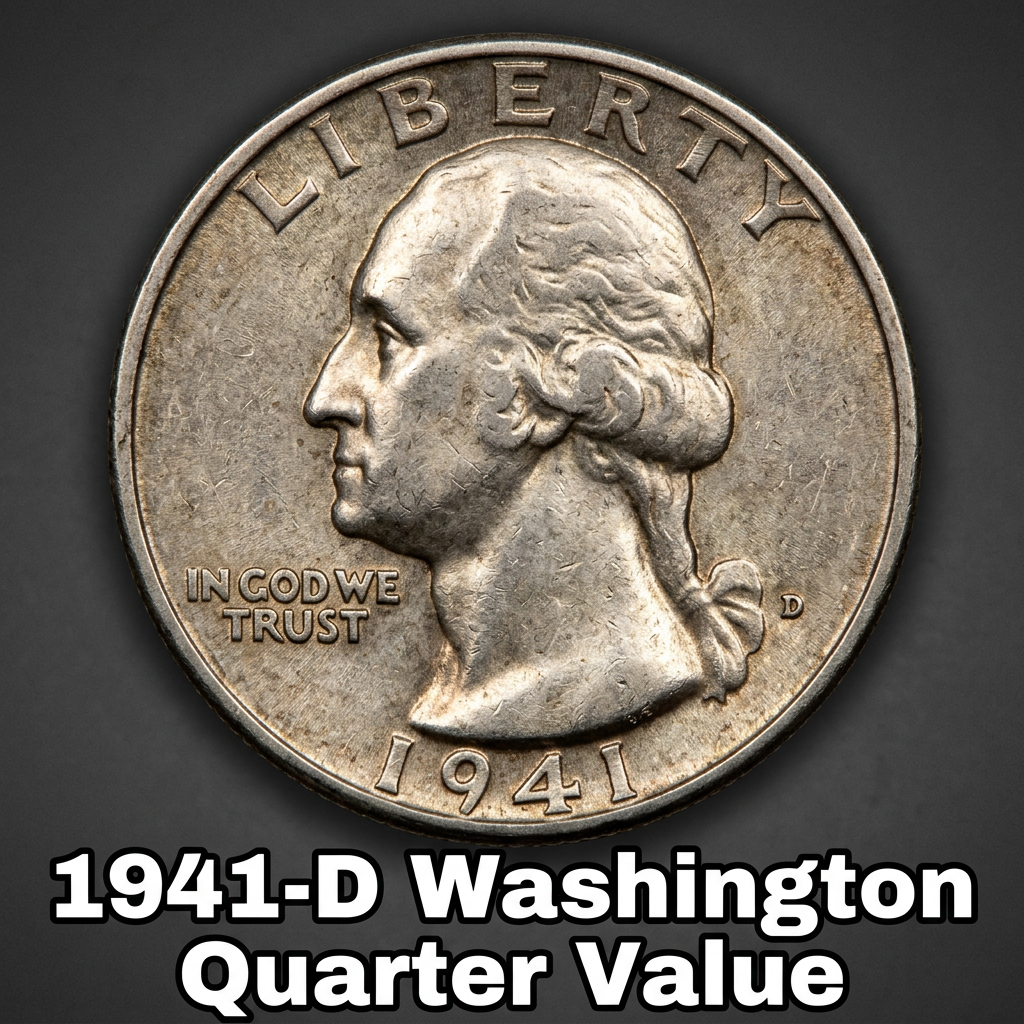
The 1941-D Washington Quarter is worth anywhere from $6 in heavily worn condition to well over $200 in uncirculated grades, with top mint state examples fetching thousands at auction. If you found one of these old silver quarters in a coin jar or inherited collection, you may be sitting on more than pocket change.
What Makes the 1941-D Washington Quarter Special
The 1941-D Washington Quarter was struck at the Denver Mint during a pivotal year — just months before the United States entered World War II. The “D” mintmark on the reverse, just above the “QUARTER DOLLAR” text, tells you it came from Denver rather than Philadelphia or San Francisco. That single letter can make a big difference in value. Denver produced around 16.7 million quarters that year, which is a decent mintage, but enough surviving coins are in better condition to make high-grade examples genuinely exciting for collectors.
If you’re not sure whether your coin is a 1941-D or another variety, a good coin identification app can help you zoom in on the mintmark and confirm the details right from your phone. Tools like CoinKnow make it easy to photograph your coin and get a quick read on what you have, which is especially helpful if you’re new to coin collecting and want to avoid guessing.
The coin is composed of 90% silver, which alone gives it an intrinsic melt value of roughly $4–$5 depending on current silver prices. But numismatic value — what collectors actually pay — goes well beyond that.
1941-D Washington Quarter Value by Grade
Condition is everything in coin collecting. A quarter that’s been in circulation for decades will show wear on Washington’s cheek, the hair details, and the eagle’s breast feathers on the reverse. Grading ranges from Poor (P-1) to Perfect Mint State (MS-70), and prices vary dramatically across that spectrum.
Here’s a general look at 1941-D Washington Quarter price data across grades:
| Grade | Description | Estimated Value |
|---|---|---|
| G-4 (Good) | Heavy wear, outline visible | $6 – $8 |
| VF-20 (Very Fine) | Moderate wear, some detail remains | $10 – $15 |
| EF-40 (Extremely Fine) | Light wear on high points | $18 – $30 |
| MS-63 (Uncirculated) | No wear, some blemishes | $55 – $90 |
| MS-65 (Gem Uncirculated) | Sharp strike, minimal marks | $150 – $275 |
| MS-67 and Above | Near perfect, rare | $1,000+ |
How to Check the Condition of Your 1941-D Quarter
You don’t need to be an expert to get a basic sense of your coin’s grade. Start by looking at Washington’s portrait under good lighting — ideally with a magnifying glass. If the hair strands above his ear are crisp and well-defined, that’s a good sign. If the cheek is flat and smooth where it should be rounded, the coin has seen significant circulation wear.
On the reverse, check the eagle’s breast. In higher grades, you’ll see distinct feather lines. In worn examples, those lines blend together into a flat surface.
CoinKnow is a great starting point for everyday people who want to evaluate coins without paying for a professional grader right away. You can scan your coin and compare it against known reference images to narrow down the grade before deciding whether to send it to PCGS or NGC for official certification.
What Affects the 1941-D Quarter’s Value Beyond Grade
Aside from condition, a few other factors can push the value of your 1941-D Washington Quarter up or down. Strike quality matters — some Denver Mint coins from this era came out of the dies with weaker strikes, particularly on the hair detail and the reverse motto. A sharply struck example commands a premium even within the same grade.
Luster is another factor. Uncirculated coins should have a frosty or cartwheel luster when you tilt them under light. Any signs of cleaning — which shows up as hairline scratches or an unnatural brightness — will significantly hurt the coin’s appeal to collectors and drop its market value.
Eye appeal, believe it or not, plays a role too. A coin with attractive, original toning (light gold or amber hues that developed naturally over decades) can actually sell for more than a bright white example of the same technical grade. Collectors have strong opinions about toning, and natural patina is generally welcomed.
For a deeper look at how much a 1941 quarter is worth across all mint marks and conditions, there are dedicated resources that break down pricing by variety and recent auction results.
Should You Sell, Hold, or Get It Graded
If your 1941-D Washington Quarter looks like it’s been in circulation most of its life — worn flat with no real detail remaining — its value is mostly tied to the silver content, putting it in the $6–$10 range. In that case, holding onto it or selling it to a local coin dealer is a perfectly fine option.
If the coin looks bright, sharp, and uncirculated, it may be worth getting it professionally graded. Third-party grading from PCGS or NGC adds credibility and can dramatically increase the price you’ll get from serious collectors. A coin you think might be MS-64 or MS-65 could net you $100–$200 or more once certified.
Not sure where to start? CoinKnow lets you photograph and research coins before you commit to grading fees, which can save you time and money if the coin turns out to be only moderately valuable.
—
FAQ
Q: How do I know if my quarter is a 1941-D and not a 1941-P or 1941-S?
A: Look at the reverse of the coin, just above the text “QUARTER DOLLAR” at the bottom. A “D” means it was minted in Denver. No letter means Philadelphia (1941-P), and an “S” means San Francisco. All three have different values, so the mintmark matters.
Q: Is a 1941-D Washington Quarter made of real silver?
A: Yes. All Washington Quarters minted before 1965 contain 90% silver and 10% copper. The 1941-D quarter weighs 6.25 grams, giving it a silver content of about 0.1808 troy ounces. At current silver prices, the melt value alone is typically around $4–$5.
Q: What’s the most valuable 1941-D Washington Quarter ever sold?
A: The highest grades — MS-67 and above — have sold for over $1,000 at major auctions. Coins certified MS-67+ with exceptional eye appeal and sharp strikes have fetched several thousand dollars from advanced collectors. The vast majority of examples, however, are worth far more modest amounts based on circulation wear.