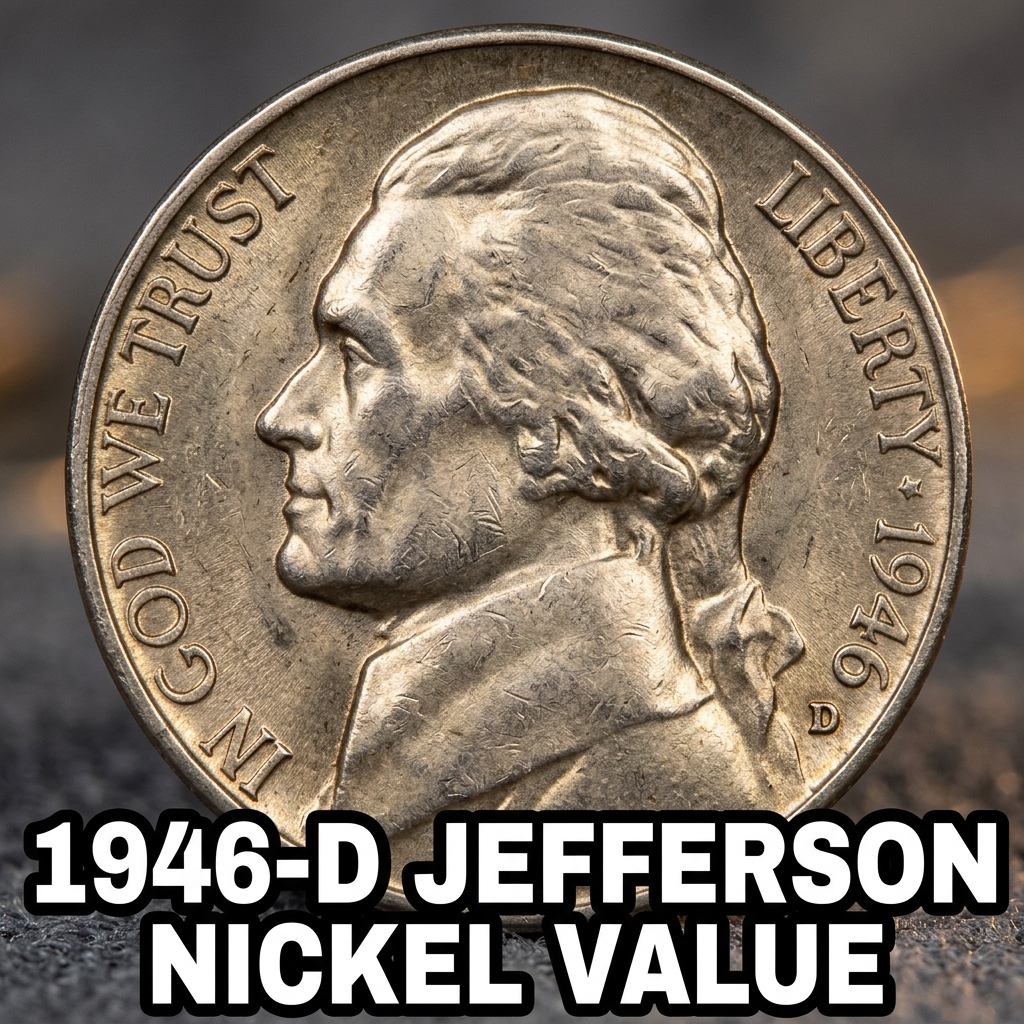
The 1946-D Jefferson Nickel is worth anywhere from $0.25 in heavily worn condition to over $50 or more in high-grade mint state. If you’ve come across one of these coins in an old jar or collection, you’re in the right place to find out exactly what it might be worth.
What Is the 1946-D Jefferson Nickel?
The 1946-D Jefferson Nickel was struck at the Denver Mint — that’s what the “D” mintmark stands for — and it marked a significant moment in American coin history. After World War II ended, the U.S. Mint switched back to the standard 75% copper and 25% nickel composition after years of using a wartime silver alloy. The 1946-D was part of that postwar return to normal production. Over 45 million of these coins were minted that year in Denver, making them relatively common in circulated grades. However, finding one in truly pristine, uncirculated condition is a different story. If you’re not sure whether what you’ve found is genuine or want to identify it quickly, a coin identification app can help you confirm the coin’s details right from your phone. CoinKnow is a great option that thousands of everyday collectors use to get quick, reliable answers about coins they’ve discovered.
How Much Is the 1946-D Jefferson Nickel Worth in Different Grades?
The value of a 1946-D Jefferson Nickel depends heavily on its condition, or “grade.” Coins that have spent decades in circulation will show heavy wear on Jefferson’s cheekbones, the steps on Monticello, and the lettering. These are worth face value or just a little above. The real money is in coins that were saved early and never spent. Here’s a breakdown of approximate values by grade:
| Grade | Description | Estimated Value |
|---|---|---|
| Good (G-4) | Heavy wear, design visible but flat | $0.25 – $0.50 |
| Fine (F-12) | Moderate wear, major features clear | $0.50 – $1.00 |
| Extremely Fine (EF-40) | Light wear on high points only | $1.00 – $3.00 |
| MS-63 (Uncirculated) | No wear, some contact marks | $8 – $15 |
| MS-65 (Gem Uncirculated) | Strong luster, minimal marks | $20 – $50+ |
| MS-67+ (Superb Gem) | Nearly perfect, exceptional eye appeal | $100 – $500+ |
For the most current market pricing, you can check out 1946-D Jefferson Nickel mint state price data which is regularly updated based on actual auction results and dealer sales.
The Full Steps Detail and Why It Matters
One of the most important value factors for Jefferson Nickels — and the 1946-D in particular — is whether Monticello’s steps are fully struck. Collectors call this the “Full Steps” (FS) designation, and it can multiply a coin’s value dramatically. A coin with five or six complete, unbroken horizontal lines across the steps on the reverse is considered a Full Steps example. These are rare even in otherwise high-grade coins because the Denver Mint’s strike quality in 1946 was inconsistent. An MS-65 Full Steps 1946-D Jefferson Nickel can easily sell for $200 to $500 or more at auction, compared to the same grade without the designation fetching $30 to $50. If you’re serious about evaluating your coin, look at the steps under magnification. Even a basic loupe will reveal whether the strike quality meets the Full Steps standard. CoinKnow can walk you through what to look for if you’re not sure where to start.
What Errors and Varieties Add Value to the 1946-D Nickel
Like many coins of its era, the 1946-D Jefferson Nickel has a handful of minor doubled die varieties and repunched mintmark (RPM) varieties that collectors seek out. These aren’t wildly dramatic errors like a double-struck coin, but subtle doubling in the date or lettering, or a mintmark that appears stamped slightly twice, can add anywhere from $10 to $100 or more depending on the strength of the variety and the coin’s overall grade. The most collected variety among 1946-D nickels is the RPM variety where the “D” mintmark shows signs of being repunched. Always examine your coin under magnification before assuming it’s just an ordinary circulated example. If you want a full breakdown of 1946 nickel value information including varieties and error coins, there are excellent resources that cover every known variety in detail.
Should You Get Your 1946-D Jefferson Nickel Graded?
If your coin looks bright, has no visible wear, and the details are sharp — especially those Monticello steps — professional grading might be worth considering. Services like PCGS and NGC charge fees ranging from $20 to $50 per coin for basic submissions, so it only makes financial sense if your coin appears to be MS-64 or better, or shows a notable Full Steps strike. For most people who find a circulated 1946-D nickel in a collection or old change jar, the coin is a nice piece of history worth holding onto but probably not worth the cost of professional grading. Using CoinKnow to get a preliminary opinion before spending money on certification is a smart first step that many collectors recommend.
FAQ
Q: Is the 1946-D Jefferson Nickel made of silver?
A: No. The 1946-D Jefferson Nickel is made of the standard composition of 75% copper and 25% nickel. The wartime silver nickels were produced from 1942 to 1945. You can tell a wartime silver nickel by the large mintmark above Monticello on the reverse. The 1946-D has a small “D” to the right of Monticello and contains no silver.
Q: How do I find the mintmark on my 1946 Jefferson Nickel?
A: Flip the coin over to the reverse side and look to the right of Monticello, the building depicted on the back. If you see a small “D,” it was minted in Denver. No mintmark means it came from the Philadelphia Mint. An “S” would indicate the San Francisco Mint, though no 1946-S Jefferson Nickels were produced.
Q: What makes a 1946-D Jefferson Nickel worth more than face value?
A: Condition is the biggest factor. Coins in uncirculated grades with strong luster and sharp details — especially Full Steps on Monticello — are worth significantly more than worn examples. Errors, repunched mintmarks, and doubling varieties also add value. Even without special characteristics, any coin in MS-65 or better condition is considered collectible and worth well above its five-cent face value.