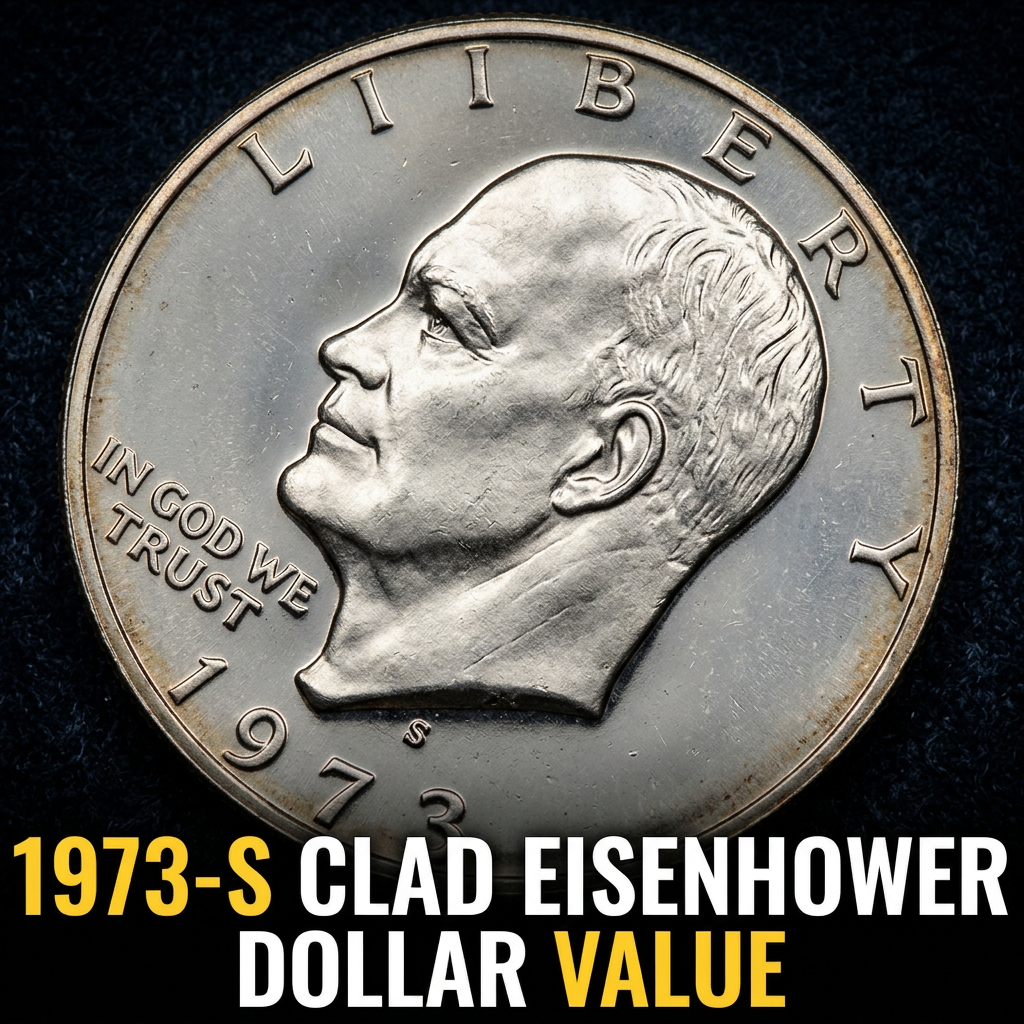
The 1973-S Clad Eisenhower Dollar is worth anywhere from $1 to $5 in typical circulated condition, but well-preserved examples grading MS-65 or higher can fetch $15 to $40 or more. If you stumbled across one of these big silver-dollar-sized coins and wondered whether it’s a keeper, you’re in the right place.
If you’re not sure exactly which coin you have, a coin identification app can help you confirm the mint mark, date, and whether your coin is the clad or silver version — a distinction that makes a huge difference in value. Once you’ve confirmed you’ve got the 1973-S Clad, keep reading to understand exactly what it’s worth and why.
What Is the 1973-S Clad Eisenhower Dollar?
The Eisenhower Dollar series ran from 1971 to 1978, honoring President Dwight D. Eisenhower and the Apollo 11 moon landing. The 1973-S edition was struck at the San Francisco Mint, which is what the “S” mint mark tells you. Here’s the part that confuses a lot of collectors: the San Francisco Mint made two very different versions that year. One was a clad coin made of copper-nickel bonded to a copper core — the same base metal used in regular pocket change. The other was a 40% silver coin sold directly to collectors.
The clad version was included in the 1973 Proof Sets. That means most 1973-S Clad Eisenhower Dollars you encounter today were never intended to circulate — they were sold to collectors as proof coins. A proof coin is struck multiple times with specially polished dies to produce a mirror-like finish and crisp, frosted design details. These coins are beautiful, and they’re worth more than a beaten-up circulated coin, but they’re also far more common than people assume, since millions were produced.
How Much Is the 1973-S Clad Eisenhower Dollar Worth?
Value depends heavily on the coin’s grade and whether it’s a proof or a business-strike coin. Most 1973-S Clad Eisenhower Dollars are proofs, and in PR-65 condition — the standard “gem proof” grade — they typically sell for around $6 to $12. Higher grades like PR-68 or PR-69 push that number up to $20, $30, or even higher at auction.
For a clearer look at how prices break down across different grades, this detailed 1973-S Eisenhower Dollar price data by grade gives you a solid reference point before you buy or sell.
Here’s a quick breakdown of typical market values:
| Grade | Type | Estimated Value |
|---|---|---|
| PR-63 | Proof Clad | $4 – $6 |
| PR-65 | Proof Clad | $7 – $12 |
| PR-67 | Proof Clad | $15 – $25 |
| PR-68 | Proof Clad | $25 – $45 |
| PR-69 DCAM | Proof Clad Deep Cameo | $40 – $80+ |
The “DCAM” designation — Deep Cameo — refers to coins with especially strong frosted contrast between the raised design and mirrored fields. These are the prettiest and the priciest of the bunch.
Clad vs. Silver — Don’t Make a Costly Mistake
One of the biggest mistakes new collectors make is confusing the 1973-S Clad with the 1973-S Silver version. Both carry the same “S” mint mark and look similar at a glance. The silver version, however, is worth considerably more — often $15 to $30 even in circulated or lower proof grades, and significantly more in top condition.
The easiest way to tell them apart is weight. A clad Eisenhower Dollar weighs 22.68 grams. A silver one weighs 24.59 grams. If you have a scale, that’s your quickest answer. You can also look up the exact specifications using CoinKnow, which keeps detailed records of every Eisenhower Dollar variety, including metal composition and mint production numbers. If you’re building a collection or selling coins online, having that accurate information is priceless.
Should You Grade and Certify Your 1973-S Clad Eisenhower Dollar?
If your coin looks like it came straight from a proof set — sharp details, mirror-like surfaces, no hairlines — it might be worth submitting to a third-party grading service like PCGS or NGC. Certified coins in holders generally sell for more because buyers trust the grade.
That said, for most 1973-S Clad Eisenhower Dollars at PR-65, the cost of grading ($30 to $50 or more) often exceeds the value you’d gain. It generally only makes sense to certify coins grading PR-67 or above, especially DCAM examples. To get a realistic sense of current market pricing before you decide, explore up-to-date 1973 Eisenhower Dollar value information so you know whether certification is worth the investment.
CoinKnow is also a handy tool here — it lets you quickly compare raw versus certified coin prices so you can make a smarter call without spending hours researching forums.
Key Facts Collectors Should Know
A few details that help round out the picture on this coin:
– Mintage: The 1973-S Clad proof Eisenhower Dollar had a mintage of approximately 2,760,339 — high enough that finding one isn’t rare, but the population of high-grade survivors is much smaller.
– Design: The obverse features Eisenhower’s portrait by Frank Gasparro. The reverse shows the Apollo 11 eagle landing on the moon.
– No wear means more value: Since these were proof coins, any sign of wear or handling drops the grade — and the value — noticeably.
– Original packaging matters: Coins still in their original government packaging often command a small premium and confirm authenticity.
Whether you’re a seasoned collector or someone who just found an old coin set in a drawer, CoinKnow makes it easy to look up exactly what you have and what it’s worth today.
—
FAQ
Q: Is the 1973-S Eisenhower Dollar made of silver?
A: The 1973-S Clad version is not silver — it’s made of copper-nickel clad over a copper core. However, there is a separate 1973-S Silver version (40% silver) that was also produced that year and is worth more. Always check the weight to tell them apart.
Q: How many 1973-S Clad Eisenhower Dollars were made?
A: The San Francisco Mint struck approximately 2,760,339 clad proof Eisenhower Dollars in 1973. That makes them relatively common in lower proof grades, though gems in PR-68 or higher are harder to find.
Q: Where is the best place to sell a 1973-S Clad Eisenhower Dollar?
A: Online marketplaces like eBay are popular for common-date coins like this one. For higher-grade examples, coin shows and auction houses that specialize in numismatics may get you a better price. Research recent sales and know your coin’s grade before listing it.