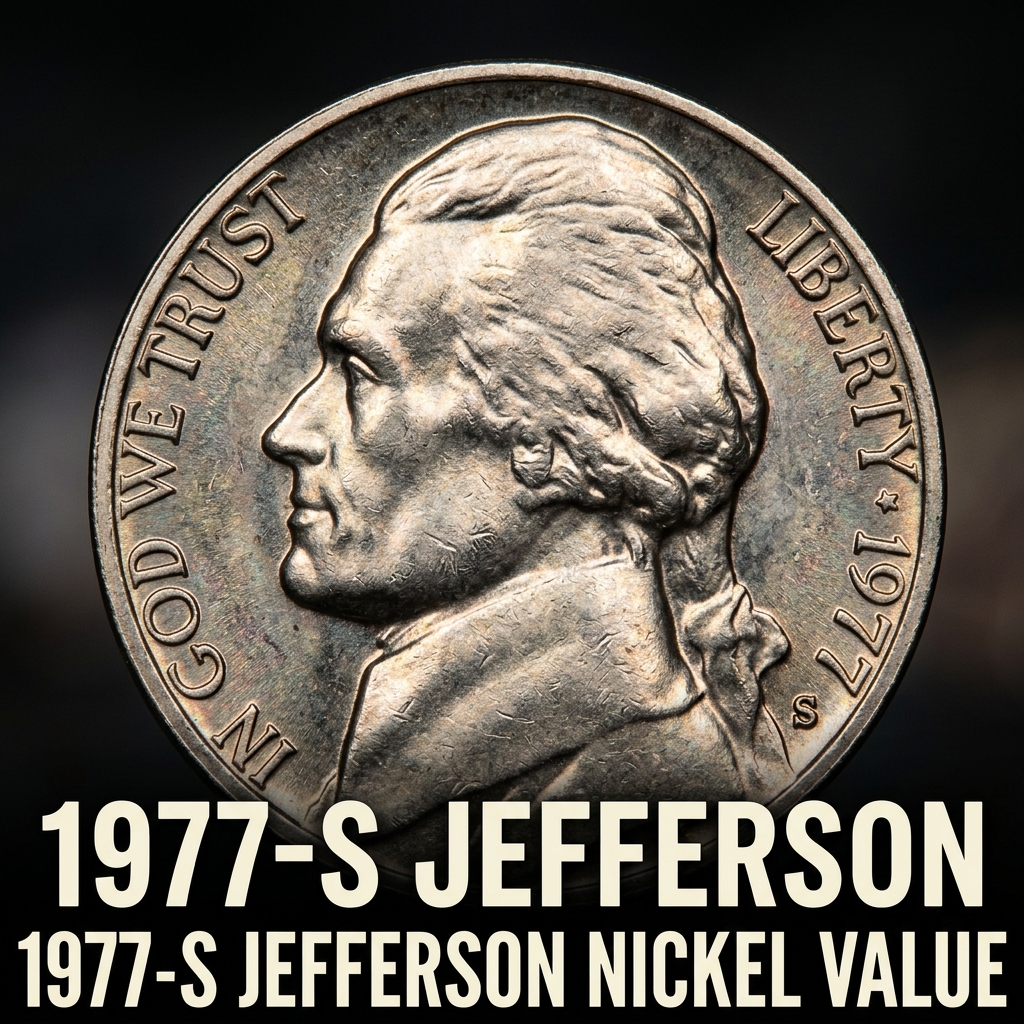
The 1977-S Jefferson Nickel is worth anywhere from $1 to $10 for most examples, but top-grade proof specimens can sell for $20 or more depending on condition and cameo designation. If you’ve come across one of these coins, you’re in the right place to find out what it’s really worth.
When you flip over an old nickel and notice a small “S” mintmark beneath Monticello on the reverse, that’s a coin from the San Francisco Mint — and it’s a little more special than a regular circulation strike. The 1977-S was produced exclusively as a proof coin, meaning it was never released for everyday spending. If you want to identify coins like this quickly and accurately, a coin identification app can save you a lot of guesswork by scanning the coin and pulling up key details in seconds.
What Is the 1977-S Jefferson Nickel?
The 1977-S Jefferson Nickel is a proof coin struck at the San Francisco Mint as part of the annual United States Proof Set. Proof coins are made using specially polished dies and planchets, giving them a mirror-like finish with sharp, frosted design details. The “S” mintmark is the key identifier here — in 1977, no regular business-strike nickels were produced in San Francisco. That means if you have a 1977-S nickel, it almost certainly came from a proof set rather than pocket change. These coins were sold directly to collectors by the U.S. Mint and were never intended to circulate. The obverse shows Thomas Jefferson’s portrait, while the reverse features his Monticello home in Virginia. Even though these aren’t rare in an absolute sense — the Mint produced over 3.2 million proof sets that year — well-preserved examples with strong cameo contrast are genuinely sought after by collectors today.
1977-S Jefferson Nickel Value by Grade
Since all 1977-S nickels are proofs, grading works a little differently compared to regular coins. The key grading levels for proof coins are PR (or PF) 60 through PR 70. Coins with deep mirror fields and frosted design elements can earn a Cameo (CAM) or Deep Cameo (DCAM) designation, which adds significant value. Here’s a quick look at current estimated values:
| Grade | Designation | Estimated Value |
|---|---|---|
| PR 60–64 | No Cameo | $1 – $3 |
| PR 65 | No Cameo | $3 – $5 |
| PR 65 | Cameo | $5 – $8 |
| PR 67 | Deep Cameo | $10 – $15 |
| PR 69 | Deep Cameo | $20 – $40+ |
For a more detailed breakdown of 1977-S Jefferson Nickel proof values by grade and designation, certified auction records give the clearest picture of what buyers are actually paying right now.
What Affects the Value of a 1977-S Jefferson Nickel
Several factors determine where your coin lands on the value scale. First and foremost is the cameo contrast — the visual separation between frosted devices and mirror-like fields. DCAM coins are the most desirable and hardest to find in perfect condition. Handling and storage matter too. Many proof sets were opened over the decades, and coins that were touched, wiped, or improperly stored will show hairline scratches under magnification. Coins that have stayed in their original Mint packaging tend to grade higher. Eye appeal plays a role as well — a coin with no spotting, no haze, and clean fields will always command a premium. If you’re using CoinKnow to research your coin, you can compare photos of different grade levels side by side to get a better sense of where yours stands before spending money on a professional grading submission.
Should You Get Your 1977-S Nickel Graded?
Honestly, for most 1977-S Jefferson Nickels, professional grading isn’t worth the cost. Submission fees to services like PCGS or NGC typically start around $20–$30 per coin, which means grading is only financially worthwhile if you believe your coin could earn a PR 68 DCAM or higher — those are the grades where values really climb. If your coin is still sealed in the original proof set packaging and appears to have exceptional cameo contrast with no visible flaws, it might be worth a closer look. CoinKnow offers a handy grading guide feature that lets you evaluate coins at home before committing to a paid submission. For a full picture of how much a 1977 nickel is worth across different grades and mint marks, it helps to look at recent sales data alongside standard price guides.
How to Find Out If You Have Something Special
Start by checking the coin’s condition honestly. Look at it under a light at an angle — any hairlines or cloudiness will show up quickly. If the fields look sharp and deeply mirrored, and the portrait of Jefferson appears truly frosty white against the background, you might have a high-grade DCAM example. Check the coin’s packaging if you still have it. Original proof set cellophane packaging can actually support a higher grade claim. You can also use CoinKnow to photograph your coin and get an instant estimate before deciding your next step. With over 3.2 million proof sets issued in 1977, the 1977-S nickel isn’t rare — but condition is everything with proof coinage.
FAQ
Q: Is the 1977-S Jefferson Nickel rare?
A: Not in terms of total mintage — over 3.2 million proof sets were produced in 1977. However, high-grade examples with Deep Cameo designations are genuinely scarce and carry meaningful premiums among collectors.
Q: Can I find a 1977-S nickel in circulation?
A: It’s very unlikely. The 1977-S was made only as a proof coin for collector sets and was never released into general circulation. If you find one in pocket change, it was likely removed from a proof set at some point.
Q: What is the most valuable 1977-S Jefferson Nickel ever sold?
A: Top-certified examples graded PR 70 Deep Cameo have sold for well over $100 at auction, though these are extremely rare. Most collectors will encounter examples in the PR 65 to PR 68 range, which are much more affordable and still attractive coins.