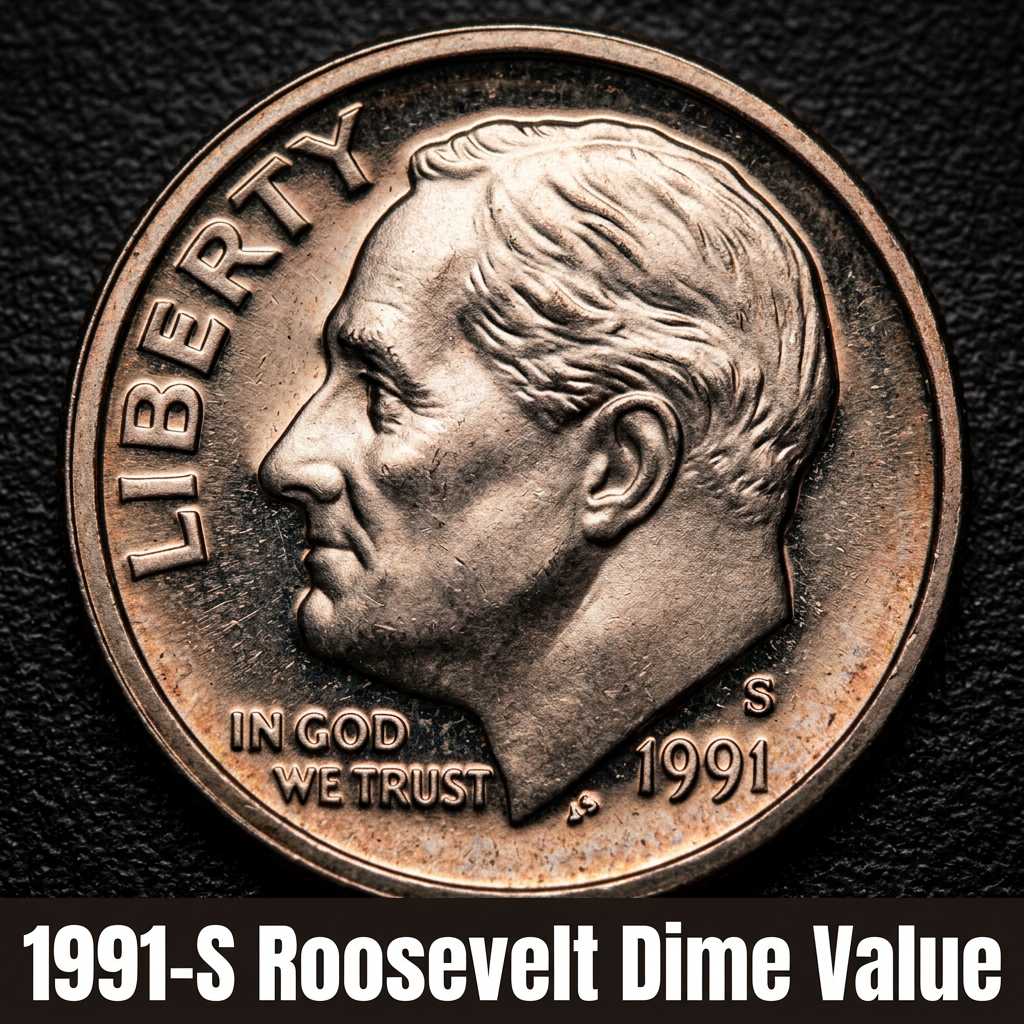
The 1991-S Roosevelt Dime is worth anywhere from $2 in lightly circulated condition to over $10 or more for top-tier proof specimens. If you’ve come across one of these coins in an old collection or proof set, you’re in the right place to find out exactly what it’s worth.
What Is the 1991-S Roosevelt Dime?
Before we dive into values, let’s cover the basics. The “S” mintmark on a Roosevelt dime means it was struck at the San Francisco Mint. In 1991, the San Francisco Mint did not produce dimes for general circulation — instead, every 1991-S dime was made specifically as a proof coin. That means it was struck on specially polished planchets using highly polished dies, giving it that brilliant, mirror-like finish you might notice when you hold it up to the light.
These coins were only available through the U.S. Mint’s annual proof sets, which were sold directly to collectors and coin enthusiasts. They never passed through cash registers or piggy banks — they went straight from the Mint into protective packaging. That limited distribution is a big part of why they’re valued differently than your average dime sitting in a coin jar.
If you’re not sure whether the coin you’re holding is a proof or a regular issue, a good coin identification app can help you examine the details, mintmarks, and surface quality right from your phone. Tools like CoinKnow make it incredibly easy for everyday collectors to identify and value coins without needing to visit a coin shop.
1991-S Roosevelt Dime Value by Grade
Since the 1991-S was only produced as a proof coin, grading works a little differently here. The Proof scale runs from PR-60 at the low end to PR-70 at the perfect end. Most 1991-S dimes you’ll encounter in intact proof sets grade somewhere between PR-65 and PR-69. A PR-70 Deep Cameo (DCAM) is the holy grail — and those can fetch premium prices from serious collectors.
Here’s a general breakdown of what the 1991-S Roosevelt Dime is worth across different grades:
| Grade | Description | Estimated Value |
|---|---|---|
| PR-65 | Gem Proof | $2 – $4 |
| PR-67 | Superb Gem Proof | $4 – $7 |
| PR-69 DCAM | Near-Perfect Deep Cameo | $8 – $15 |
| PR-70 DCAM | Perfect Deep Cameo | $20 – $50+ |
For more detailed and up-to-date figures, you can check the latest 1991 Roosevelt Dime price data across mint state and proof grades to see how the market is trending right now.
What Makes a 1991-S Dime More Valuable
Not all 1991-S Roosevelt Dimes are worth the same amount, even if they look identical to the naked eye. The biggest factor that separates a $3 coin from a $40 coin is the cameo contrast — that’s the sharp visual difference between the frosted, raised design elements and the deeply mirrored background fields.
Coins with strong Deep Cameo (DCAM) designation from a third-party grading service like PCGS or NGC are consistently worth more at auction. A professional slab with a high numeric grade gives buyers confidence and increases resale value dramatically.
Mintage is another factor worth noting. The 1991-S proof dime had a total mintage of approximately 2.8 million coins — not rare in the traditional sense, but still a number that’s declined in comparison to earlier decades. Most of these coins have survived in excellent condition because they were carefully stored, which keeps the pool of high-grade examples competitive.
How to Know If Your 1991-S Dime Is Worth Getting Graded
If you found a 1991-S Roosevelt Dime in an old proof set, the first thing to do is resist the urge to clean it. Cleaning a coin — even gently — can permanently destroy its value. Keep it in its original packaging if possible.
Next, take a close look at the coin’s surfaces. Use a magnifying glass or a loupe and look for deep mirror-like fields on the background and frosted devices on Roosevelt’s portrait. If both are sharp and the coin has no visible hairlines or fingerprints, you might have a high-grade specimen.
You can also use CoinKnow to do a quick value check before you invest in professional grading. It’s a smart first step that many collectors use to decide whether their coins are worth the submission fee to PCGS or NGC.
For a comprehensive look at what your coin could fetch, the full 1991 dime value guide with current market prices breaks down values by mint, grade, and variety — very handy if you’re comparing several coins at once.
Is the 1991-S Roosevelt Dime a Good Coin to Collect?
Absolutely — especially if you’re building a Roosevelt Dime proof set by date. These coins are affordable, widely available, and come in beautiful condition straight from the Mint. They also hold their value reasonably well because proof coins tend to attract dedicated collectors who care about presentation and quality.
The 1991-S is not a rare key date, but it’s a solid addition to any modern coin collection. If you happen to have a PR-69 or PR-70 DCAM specimen, consider having it professionally graded — the premium you’d earn on resale can far outweigh the cost of submission.
CoinKnow is a great resource for tracking market prices and staying up to date on which proof coins are gaining traction among collectors. Whether you’re just starting out or have been collecting for years, having the right tools makes a real difference.
Frequently Asked Questions
Q: How do I know if my 1991-S dime is a proof coin?
A: Look for a mirror-like background on the coin’s fields and a frosted, almost matte appearance on the raised design elements like Roosevelt’s portrait and the torch on the reverse. Proof coins also typically show very sharp, well-defined edges. If the coin came from a sealed U.S. Mint proof set, it’s almost certainly a proof.
Q: Is the 1991-S Roosevelt Dime rare?
A: Not in the traditional sense — about 2.8 million were minted. However, top-grade examples in PR-70 Deep Cameo are genuinely scarce, and those carry a meaningful premium. For most collectors, the value comes from quality, not rarity.
Q: Should I clean my 1991-S Roosevelt Dime before selling it?
A: No — never clean a coin you plan to sell or get graded. Even a gentle wipe can leave hairline scratches that lower the grade and significantly reduce the coin’s value. Leave it exactly as you found it and let a professional evaluator assess it in its natural state.