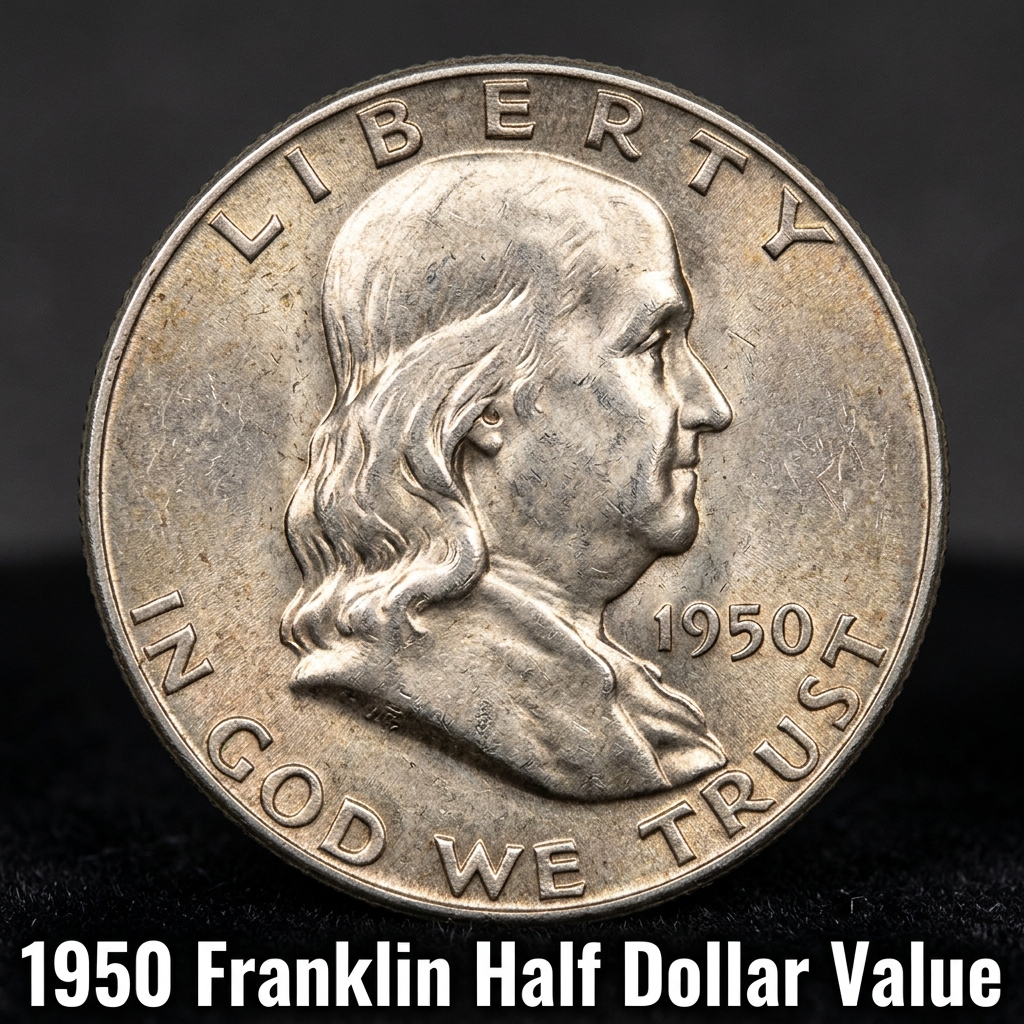
The 1950 Franklin Half Dollar is worth anywhere from $12 in heavily circulated condition to over $500 or more in high-grade mint state — and certain mint mark varieties can push that number even higher. If you found one of these silver coins tucked away in a drawer or inherited a collection, you’re in the right place.
What Is the 1950 Franklin Half Dollar?
The Franklin Half Dollar series ran from 1948 to 1963, featuring Benjamin Franklin on the obverse and the Liberty Bell on the reverse. The 1950 issue was struck at two mints: Philadelphia (no mint mark) and Denver (D mint mark). These coins are composed of 90% silver, which alone gives them significant melt value regardless of condition. If you’re not sure which coin you have or need help identifying the mint mark location, a coin identification app can walk you through the details quickly and accurately. The mint mark, if present, appears on the reverse above the Liberty Bell. Understanding exactly which variety you have is the first step in determining what your 1950 Franklin Half Dollar is really worth.
1950 Franklin Half Dollar Value by Condition and Mint Mark
Coin values change dramatically based on grade and mint mark. The 1950 Philadelphia issue had a relatively low mintage of around 7.7 million coins, while the 1950-D from Denver had a slightly higher production. Both are considered scarce in high grades, which is great news if you’ve kept yours in good shape.
Here’s a quick reference table for current market values:
| Coin | Good (G-4) | Fine (F-12) | Extremely Fine (EF-40) | MS-60 | MS-65 |
|---|---|---|---|---|---|
| 1950 (Philadelphia) | $12 | $14 | $18 | $65 | $500+ |
| 1950-D (Denver) | $12 | $14 | $18 | $55 | $350+ |
For a more detailed breakdown of 1950 Franklin Half Dollar prices across all mint state grades, it’s worth reviewing professional pricing databases that track recent auction results.
Silver Content and Melt Value
One reason the 1950 Franklin Half Dollar holds its value so well is the silver. Each coin contains 0.3617 troy ounces of pure silver. With silver trading around $28–$30 per ounce at the time of writing, the raw melt value of any 1950 Franklin Half Dollar sits around $10–$11. That means even a heavily worn example retains real, tangible worth just from the metal alone. This is an important baseline to understand: no matter what condition your coin is in, it’s never truly “worthless” as long as it contains silver. Collectors and dealers always pay at least melt value for 90% silver coins, and in most cases, considerably more.
What Makes Some 1950 Franklin Half Dollars More Valuable
Beyond the standard date and mint mark, there are a few factors that can significantly boost the value of your coin. Full Bell Lines (FBL) is the most important designation to know. On Franklin Half Dollars, the horizontal lines across the bottom of the Liberty Bell tend to wear quickly during the striking process and through circulation. When a coin has sharp, complete bell lines, it earns an FBL designation from grading services like PCGS or NGC — and that can multiply the value several times over. A 1950 MS-65 FBL example, for instance, can fetch well over $1,000 at auction. Luster, strike quality, and the absence of contact marks also play a major role. CoinKnow is a handy tool that helps everyday collectors understand these grading nuances without needing to be an expert. If you want a comprehensive look at what your 1950 Half Dollar is worth based on grade and variety, dedicated coin value resources make that research much easier.
Should You Get Your 1950 Franklin Half Dollar Graded?
If your coin looks like it’s in uncirculated or near-uncirculated condition — meaning the surfaces are bright, there’s original luster, and the details are sharp — professional grading could be well worth the cost. Grading fees from PCGS or NGC typically run $30–$50 per coin for standard service, but if your coin grades MS-65 FBL or higher, the return on that investment could be substantial. For coins in circulated grades, professional grading usually doesn’t make financial sense unless you suspect a rare variety. CoinKnow can also help you do a preliminary assessment before spending money on third-party grading. When in doubt, consulting a local coin dealer for a quick in-hand evaluation is always a solid move. They can spot things that photos sometimes miss and give you honest feedback on whether your coin is worth submitting.
FAQ
Q: How do I know if my 1950 Franklin Half Dollar is silver?
A: All Franklin Half Dollars, including the 1950 issue, are struck in 90% silver. If the coin is dated between 1948 and 1963 and looks like a half dollar, it contains silver. You can verify by checking the edge — a silver coin will show a solid silver-gray edge, while a clad coin shows a copper stripe.
Q: What does the “D” mint mark mean on a 1950 Franklin Half Dollar?
A: The “D” stands for Denver, meaning the coin was produced at the Denver Mint. You’ll find the mint mark on the reverse side of the coin, just above the Liberty Bell. A coin without a mint mark was struck in Philadelphia. CoinKnow can help you locate and identify mint marks if you’re unsure.
Q: Is a 1950 Franklin Half Dollar rare?
A: The 1950 Philadelphia issue had a mintage of about 7.7 million, which is relatively low for the series, making it moderately scarce — especially in high grades. It’s not considered a key date, but it’s one of the more sought-after issues among Franklin Half Dollar collectors, particularly in MS-65 FBL condition where it can command strong premiums.