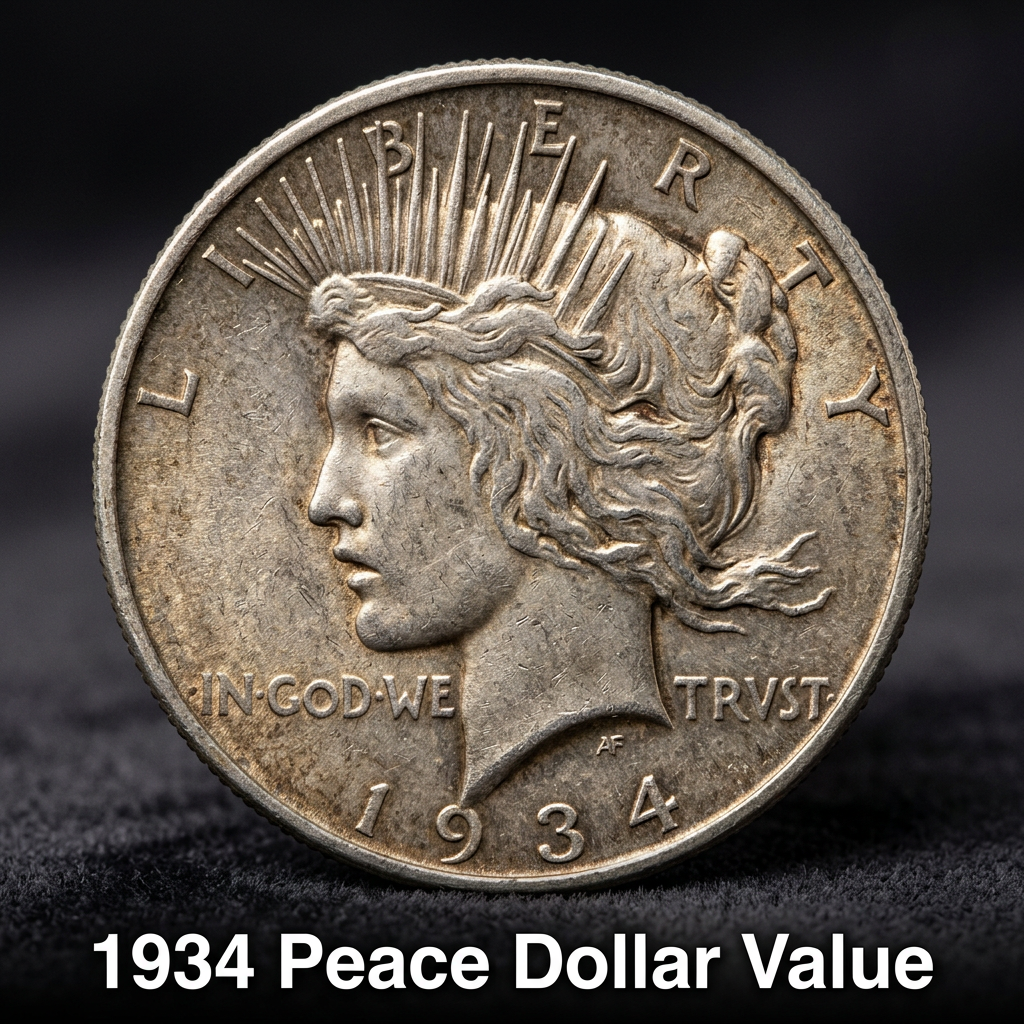
The 1934 Peace Dollar is worth anywhere from $25 in heavily worn condition to over $1,000 or more in high mint state grades. If you found one of these silver dollars tucked away in an old collection or inherited it from a relative, you’re holding a coin with real numismatic value — and this guide will help you understand exactly what you’ve got.
What Is the 1934 Peace Dollar?
The Peace Dollar was minted from 1921 to 1935 as a symbol of peace following World War I. Designed by sculptor Anthony de Francisci, it features Lady Liberty on the obverse and a bald eagle perched on a rock on the reverse. The 1934 Peace Dollar was struck at two mints: the Philadelphia Mint (no mint mark) and the San Francisco Mint (S mint mark). Both versions are 90% silver, containing 0.7734 troy ounces of pure silver. If you’re not sure which version you have, a coin identification app can help you quickly identify the mint mark and variety from a photo. The 1934-S is generally the more valuable of the two, as it had a lower mintage and is harder to find in higher grades. Understanding which coin you have is the first step toward knowing its true value.
1934 Peace Dollar Value by Grade and Mint Mark
The condition — or grade — of your 1934 Peace Dollar has a huge impact on its value. A coin that has been heavily circulated will show significant wear on Liberty’s face and hair, and the eagle’s feathers will be flattened. These coins are still worth money for their silver content alone. Higher-grade examples with sharp details and original luster can be worth many times more. Below is a general value table to give you a quick reference:
| Grade | 1934 (Philadelphia) | 1934-S (San Francisco) |
|---|---|---|
| Good (G-4) | $25 – $30 | $30 – $40 |
| Very Fine (VF-20) | $35 – $50 | $50 – $70 |
| Extremely Fine (EF-40) | $50 – $75 | $80 – $120 |
| Mint State (MS-63) | $150 – $250 | $400 – $700 |
| Mint State (MS-65) | $500 – $1,000+ | $2,000 – $5,000+ |
For the most current auction data and price trends, you can view detailed 1934 Peace Dollar price data by grade and mint mark to see what these coins are actually selling for in today’s market.
How to Determine the Grade of Your 1934 Peace Dollar
Grading your own coin takes a little practice, but even a beginner can get a rough sense of condition. Start by looking at Liberty’s cheek and hair above her ear — these are the high points and the first areas to show wear. On the reverse, check the eagle’s breast feathers and the area around the word PEACE on the rock. If the details are sharp and you can see original mint luster (a faint cartwheel shine when you tilt the coin under light), your coin is likely in the mint state range. If the surfaces are dull and the design elements are flat, it’s a circulated coin. A professional grading service like PCGS or NGC can give you a certified grade, which also protects you when selling. CoinKnow is another great tool for collectors at every level — it can guide you through visual grading with your smartphone camera and give you an instant value estimate without needing to visit a dealer right away.
Silver Melt Value and Why It Matters
Even a well-worn 1934 Peace Dollar is never truly “worthless” because it’s made of 90% silver. The coin’s silver melt value fluctuates with the spot price of silver. When silver trades around $28 per troy ounce, the melt value of a Peace Dollar is approximately $21.65. This acts as a price floor — no matter the condition, your coin should be worth at least this amount. When silver prices rise, so does the baseline value of every 1934 Peace Dollar in existence. Knowing the melt value is especially helpful if you’re dealing with heavily circulated coins that have little collector premium. CoinKnow automatically updates silver melt values in real time, so you always know exactly where your coin stands on any given day.
Where to Sell a 1934 Peace Dollar
If you’ve decided to sell, you have several options. Local coin dealers are convenient, but they typically offer 60–80% of a coin’s retail value since they need room for profit. Online platforms like eBay and Heritage Auctions expose your coin to a much wider audience and can result in stronger prices, especially for higher-grade examples. For coins worth submitting to PCGS or NGC, getting a certified grade first almost always increases the final sale price. If you want a thorough breakdown before you sell, check out this comprehensive resource covering 1934 Peace Dollar values across all grades and mint marks. CoinKnow also has a built-in marketplace feature that connects sellers with verified buyers, making the process straightforward even for first-time sellers.
Frequently Asked Questions
Q: How do I tell the difference between a 1934 and a 1934-S Peace Dollar?
A: Look at the reverse of the coin, just above the eagle’s tail feathers and to the left. If you see a small “S” mint mark, it was struck in San Francisco and is the rarer, more valuable variety. No mint mark means it came from Philadelphia.
Q: Is a 1934 Peace Dollar rare?
A: The 1934 Philadelphia issue had a mintage of about 954,057 coins, making it a lower-mintage year but not extremely rare in circulated grades. The 1934-S, with just 1,011,000 struck, is rarer in high mint state condition and commands significant premiums in grades MS-64 and above.
Q: Should I clean my 1934 Peace Dollar before selling it?
A: No — never clean a coin before selling it. Cleaning removes the original surface and drastically reduces collector value. Even a coin that looks dull or dirty is worth more in its original, uncleaned state to any serious buyer or dealer.